DAY 19 CALAIS TO WISSANT

It was rather foggy as we left the Auberge de la Jeunesse close the beachfront, but the sun was already beginning to break through promising another unusually warm day for March.

The seafront here is a strange mixture between ‘functional’ apartment blocks possibly dating from the sixties, and newly created public leisure space. The latter, most likely funded by EU money, does rather well in improving what would otherwise appear rather shabby and down at heel. It was good to see that even at this hour there were a fair number of people out exercising.

Calais beach’s well used skatepark

After a kilometre or so the route disgorged us onto a wide sandy beach. Quickly we learned to look for the harder sand as that closer to the dunes was worse than freshly fallen snow to walk on.

Bleriot plage – miles of sand

Although the sun shone all day, it never burned off the sea mist which obscured views of the Channel, with frequent ferries emerging out of the haze as they plied to and from Calais. We noted many more people out walking, running and exercising their dogs than we had seen in Kent.

First stop was the modern looking church of Notre Dame de Cap Blanc in Sangatte. In one corner stands a large model of a cave with the Virgin Mary and kneeling below a young girl praying, symbolic, we presume of the Lourdes appearance. No recognition of the pilgrim route since this stage is a modern addition to connect with Calais after the lagoon port at Wissant silted up.

From Sangatte the path rises gently uphill at first through rolling arable farmland and nature reserves, with glimpses of Cap Blanc Nez in the distance. On a clear day we would have been able to see the Kent coast, but it was not to be. All along this coastline there is evidence of the concrete fortifications of Hitler’s Atlantic Wall, and pock-marked ground from the heavy shelling inflicted on this part of France during WW2.

Heavily shelled area behind Cap Blanc Nez

A steep climb to a radar station and descent to the road brought us down to Cap Blanc Nez where a prominent obelisque visible for many miles in every direction recognises the heroism of the First World War Dover Patrol, a combined Anglo-French operation to keep the Channel open for shipping. Many local fishermen were lost attempting to disarm the mines laid by German warships. Sadly we found the monument covered in graffiti, though all the paths around it are very well maintained thanks presumably to EU funding.

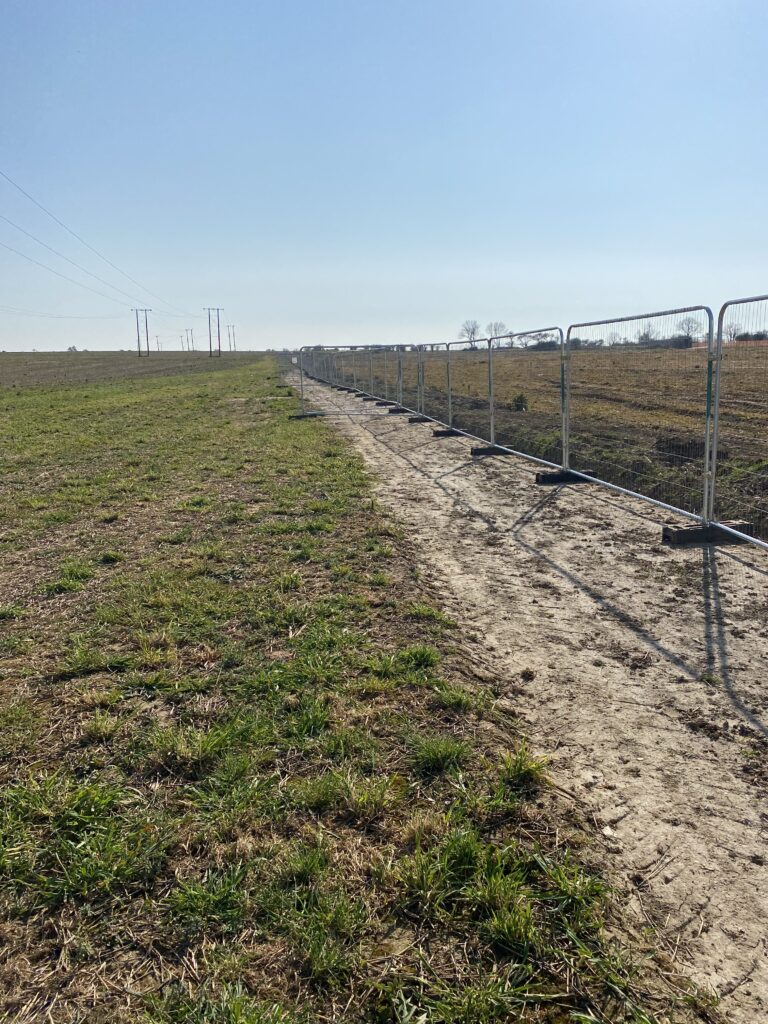
The road to Wissant has attracted motorcyclists for its steep undulations and thrilling bends since the last century, and that tradition seems to continue, so we were glad that our path took us away from the road and back towards the more restful sound of waves breaking on the beach. Curiously, and despite extensive areas of fenced off nature reserve, we heard few birds other than larks and saw no wild flowers other than daisies. We wondered whether the way the adjacent land was being farmed, with obvious use of artificial fertilisers and no hedgerows, may have had something to do with the lack of biodiversity.

Descent towards Escalles and the beach

A winding descent down to the small hamlet of Escalles brought us back onto the cliffs above the beach, and an undulating path towards Wissant, the original port for English pilgrims setting out for Rome before the harbour silted up.

WW2 fortifications beyond Cap Blanc Nez

The final stretch into Wissant took us along the beach, which was even better used than around Calais, with many people out walking and a group of kite surfers enjoying the brisk easterly breeze. We were very fortunate that the tide was in our favour today, enabling us to use the beach and avoid either struggling through sand dunes or tramping along a busy main road.

Back onto the beach heading for Wissant


With the tide well out all day we enjoyed good firm sand to walk on

At Wissant we found the Church of St Nicolas where the choir was doing some note-bashing after a service, judging by the air heavy with the smell of incense. Surprisingly, they appeared to be unaware of the Canterbury cross inside the church or the plaque outside commemorating Thomas a Becket’s departure from Wissant on 1st December 1170, on what turned out to be his way to martyrdom at the hands of Henry II’s knights. Here was another church on the Via Francigena – in this instance, at the original port of arrival/ departure of pilgrims from/ to Canterbury – which seems to be completely unaware of its historical importance and role as a pilgrim church. No pilgrim stamp to be found here either. Rather disappointing.

However, we did find an excellent restaurant with fresh seafood on the menu which, with a nice bottle of Muscadet, did much to assuage any disappointment about being unable to stamp our pilgrim passports today! As we leave the coast behind this was probably our last opportunity for fresh seafood until we reach the Italian coast…….so we decided we would splash out!

DAY 18 FRANCE AT LAST!

Here we are in Calais at last! But not thanks to P&O Ferries.

We wrote earlier about the message P&O Ferries sent us, saying that despite our booking they were withdrawing foot passenger services from 17th March for “operational reasons”. Subsequently they told us it was for the safety and overall well-being of all their customers. We didn’t know whether we should feel insulted by that or confused as to what it really meant. They offered us the opportunity to cross by car, but of course we are not travelling with a car. Not many pilgrims do. We wrote to their CEO appealing for his help to get us across, but that didn’t solicit any helpful response. We contacted BBC Radio Kent to see if a little publicity about our plight might lubricate the door hinges, but still got no better assurance than that they were exploring all options. Then on the morning of 17th March we received a text from our BBC contact to say that P&O Ferries were recalling all ships to port. Next followed the news that they were sacking all 800 of their seagoing employees on 30 minutes notice, to replace them with overseas agency workers on a fraction of the pay and well below the UK National Minimum Wage. The rationale for this? That the company had lost £100m in 2020 (the year of Covid lockdowns) and such is unsustainable. We don’t know of many companies that didn’t lose money in that awful year. Meanwhile we read that they paid out £270m in dividends to their shareholders (the Dubai Royal Family) for the same year, and took advantage of £14m of UK taxpayers’ money in furlough assistance. The whole story is really quite appalling. Our misfortune over our crossing pales into insignificance in the context of the tragedy for the hundreds of loyal employees and their families.

On this journey so far, we’ve experienced a number of difficulties which at times have appeared as significant barriers to us. There have been the storms, the mud and of course the Covid Pandemic, which set things back by nearly two years. But the one thing we’ve learned as pilgrims is that there is always a way through or around eventually, if not immediately obvious at first.

Today, that way around came in the form of Tom’s old childhood friend Ed and his lovely wife Jane who came to our rescue and offered to drive us across via the tunnel!

Sunrise over Dover Harbour with the P&O Ferries moored up alongside the Eastern Dock

So it was that Ed and Jane picked us up from our Dover seafront hotel and drove us to the tunnel terminal in Folkestone. Despite our concerns about the newly imposed bureaucracy, all went smoothly and we were soon on our way under, rather than over the Channel. Once on the other side it was just the same as it always was pre-Brexit and pre-Covid. It seems that the bureaucracy is all taken care of ahead on-line. Perhaps instead of worrying about these ways of doing things, we should just get used to them.

The famous Hotel de Ville of Calais

We had a lovely day with Ed and Jane. After an al fresco lunch, we visited the Hotel de Ville, whose famous belfry tower can be seen from many miles offshore, and serves as a valuable landmark when crossing the Dover Strait. The gardens in front of it were in full bloom with colourful polyanthus, tulips, hyacinths, daffodils and lilies, radiant in the spring sunshine. It was a thrill to visit the famous Rodin sculpture of the Burghers of Calais at last. Whenever we’ve arrived via the tunnel before, we’ve sped off down the Autoroute without a thought of exploring Calais itself. Now we are going to stop and take in all those places along our route south, doing it the slow way.

The Burghers of Calais

After a lovely day together Ed and Jane delivered us to our Auberge de Jeunesse close to the beach and we said our goodbyes, with promises for a campervan trip together when we return later in the summer.

The kindness of friends!

DAY 17 SHEPERDSWELL TO DOVER

A short train ride from Kearsney, near our overnight billet, back up the valley to Shepherdswell where we left off yesterday. On our walk to the station we passed a group of bin men at work. On greeting one of them “good morning”, his response was “good morning, young man”. Tom was rather tickled by that!

On arriving in Sheperdswell, we made our way to the church of St Andrew to pay our respects and stamp our pilgrim passports. A Victorian building, St Andrew’s was perhaps not as interesting as some of the much earlier churches we’ve visited along the way, but seemed to be well supported with a lively church community.

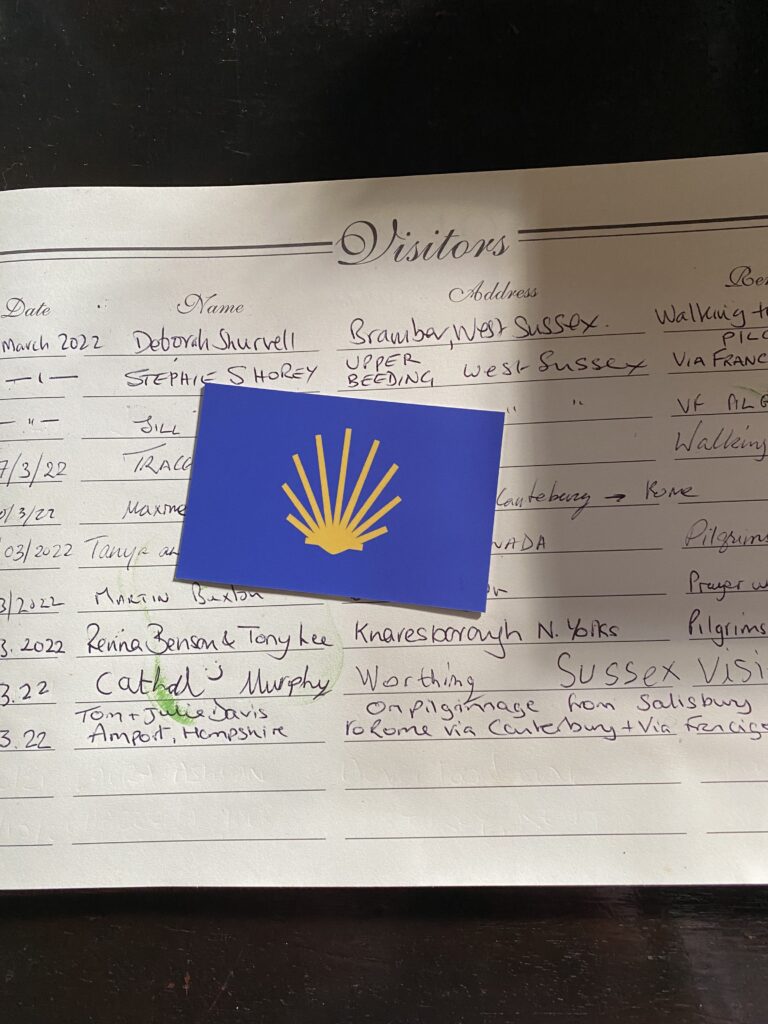
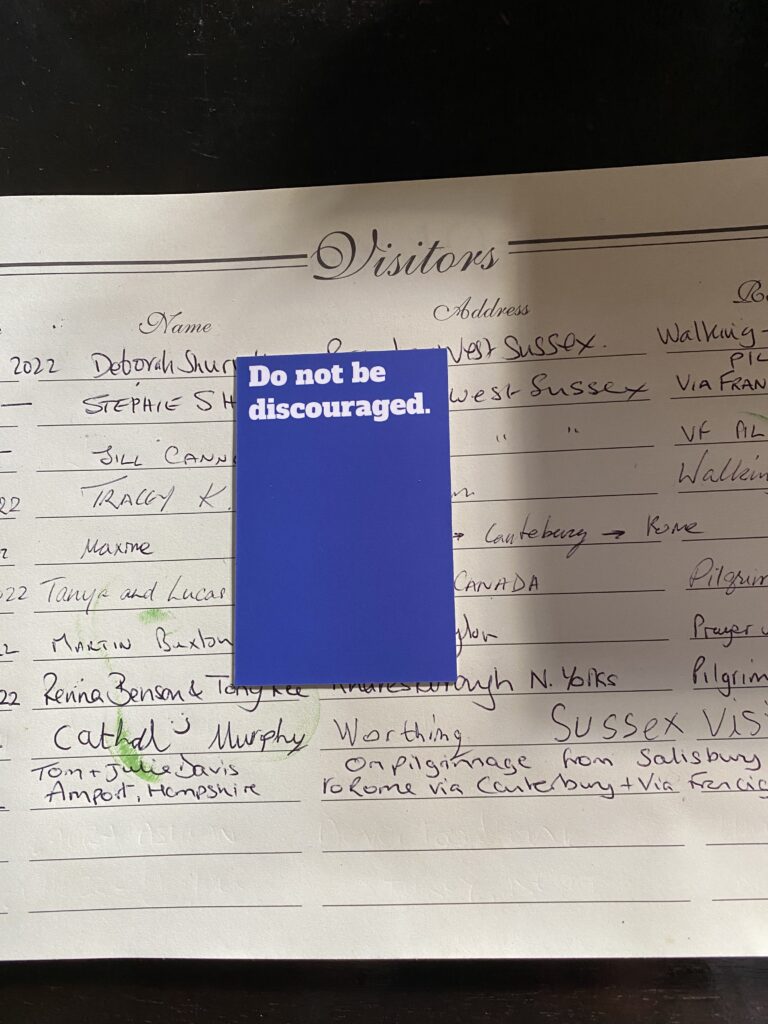
At a number of the churches we’ve called in on we’ve found little blue cards with the sign of the pilgrim shell and on the reverse side “do not be discouraged”. It’s clearly a message directed at pilgrims but we’d love to know more about what lies behind them. Maybe this will be revealed as we progress.

From Shepherdswell (also described as Sibertswold) we headed east through largely arable country. No more orchards or hop gardens. Soon we came upon another ‘artistic installation’: this time a wooden structure which at first we thought resembled the dome of St Peter’s in Rome, but according to the adjacent interpretation board represented a proposed cupola to top the Belvedere Tower across the valley. The title ‘Monumenta Romana’ suggests that we might have been correct in our assumptions.

‘Artistic’ installation with the Belvedere Tower in the distance

The Belvedere Tower which is part of the Waldershare Park estate was a 18th century folly, probably designed by Colen Campbell for the Furness family who owned the Waldershare House and estate.

On the other side of the Waldershare Estate we came upon a small chapel dedicated to All Saints. At present disused, it is looked after by the Churches Conservation Trust. What a crying shame that the current owners of Waldershare House don’t take a more active role in looking after THEIR church!

Originally Norman, it has been much modified over subsequent centuries. Particularly striking are the murals behind the alter depicting the four Evanglists.

The Four Evangelists at All Saints Waldershare

On leaving All Saints Julie took a nasty tumble on a piece of broken tarmac. Fortunately injury was limited to a grazed knee, but it was a reminder to us of how careful we need to be.

The approach to Dover which had been long anticipated – views of the channel and Dover Harbour – was something of a disappointment. First there was a significant detour to find a way to cross the busy A2 dual carriageway, followed by a second (so called temporary) detour to circumvent a construction project by Galiford Try. The project completely straddles and obliterates the Roman Road which the Via Francigena follows, diverts it by about a kilometre and when it rejoins the line of the road there is no signposting whatsoever. We understood that the reason for the diversion was for archaeological work to be done, but there was absolutely no evidence of anything happening, other than marking out for a new construction development! Surely, such a development should be designed around a Roman Road and ancient pilgrimage route like this? What are Dover District Council doing?

  • *
Diversion of the Via Francigena and the Roman Road from Richborough by Galiford Try – for what reason?

The descent into Dover is distinctly uninteresting. There are no views of the sea, the port or the harbour. It’s only when you come upon the urgency of the traffic and the absence of waymarks for anything other than motorised vehicles that you realise you’ve reached Dover! So, once again we have to get the compass and GPS out to establish where we are and where we need to go.

However we did find Salisbury Road and a magnificent Magnolia, which made us feel welcome, given where we’d walked from!

Soon after we found our way to the sea front and our overnight billet with a harbour view.

DAY 16 CANTERBURY TO SHEPHERDSWELL

After several last-minute panics – organising an alternative Channel crossing to P&O; new post-Brexit border bureaucracy complicated by Covid; and obtaining a data SIM that actually did accommodate roaming – we left the southwest door of Canterbury Cathedral in lovely spring sunshine.

Departing Canterbury Cathedral

We attended Choral Evensong yesterday at the Cathedral sung by the Boy Choristers and Lay Clerks. We were given a warm welcome by the stewards enthused by our pilgrimage. The music was lovely. We wondered if our friend John from St John Singers, who was once a Lay Clerk here, was live-streaming the service as he often does. We met another couple from Salisbury, actually Great Wishford where Tom fished for many years. She was a former midwife at the Salisbury Hospital where Julie worked. It turned out we had a number of mutual friends. They spoke about someone from Winterbourne Stoke who is walking to Rome to raise funds for the church roof. We’d heard about this from someone else. He’s already got to Besancon and is apparently returning later this year to continue with his wife. We must make contact.

We headed out of the walled city past the ruin of St Augustine’s Abbey followed by Canterbury Christchurch University. That’s a new one on us. Is it the Canterbury Art College of old?

As is often the case, navigation out of the urban area was slightly challenging, though eventually we found some signposting for the Via Francigena, which reassured us.

Wide-open countryside greeted us, mostly arable land now, but much evidence of former hop gardens.

After a few miles we came upon Patrixbourne with its fascinating Norman Church of St Mary. Patrixbourne is the crossing point of no fewer than four long distance paths, but the Via Francigena is clearly the most important.

Having become used to the warm spring weather the inside of the church was decidedly chilly. We were somewhat amused by the inadequacy of a tiny electric wall heater, which reminded us of previous attempts to address heating at our own church before an incoming cohort of parishioners got on, raised the funds and sorted it.

St Mary Patrixbourne SW door

The main SW door was of particular interest with its ornate rounded Norman arch and thick oak door. Inside we signed the visitors book and stamped our pilgrim passports. An interesting and knowledgable visitor remarked on the skewed arch separating the chancel from the nave. Had it slipped over the years or was the horseshoe shape as it was built?

Reminders of the emerging spring appeared at every turn. With most hawthorn now fully in leaf, we saw newly green hazels and our first sighting of a cowslip!

A little later we came upon a patch of wood anemones in full bloom. What a show of spring!

West of Wymenswold we found what appeared at first sight to be a bench but on closer inspection was an artistically licensed relief depicting the route of the Via Francigena. Most of it looked pretty flat until the Alps rise almost vertically out of the landscape.

Relief of the Via Francigena

Quite daunting really!

At Wymenswold we discovered that its meaning in Old English was ‘the forest of the people of Wimel’ and that the local area was once extensively forested. There is evidence of Bronze Age barrows and other earthworks, including a more recent bomb crater dating from WW2, now blending into its surroundings. Today, all around Wymenswold there are huge fields under cultivation with larks singing above, and only the occasional small stand of trees. The pilgrim church is dedicated to St Margaret of Antioch, the patron Saint of pregnancy and childbirth. Again, the church seemed very large for the size of the village, presumably thanks to wealthy local benefactors.

Onwards we followed an undulating path along the edges of large fields before plunging back into a sunken path bounded by trees giving beautiful dappled light from the late afternoon sun.

The final stretch along tarmac roads and through paddocks linked to a riding stables brought us into Shepherdswell, our staging post for the day. As all the local B&Bs seem to have stopped trading we caught a train towards Dover, by luck with just 5 minutes to spare, and found our billet in River, a village on the outskirts of Dover. We will return to Shepherdswell by train tomorrow to pick up where we left off as we can’t start our first day on the Via Francigena by taking a shortcut!

St Margaret of Antioch, Wymenswold

DAY 15 – ARRIVAL IN CANTERBURY

Another excellent overnight lodging at the Woolpack Inn at Chilham, with cheerful and welcoming staff.

A bright morning welcomed us as we climbed up the hill to St Mary’s Church, past some wonderful medieval houses.

The church was open but finding the stamp for updating our pilgrim passports was less easy. A large building on top of the hill, opposite the gate to Chilham Castle, the church was clearly well endowed by successive castle owners. One in particular, James Wildman, also owner of plantations in Jamaica, campaigned with William Wilberforce for the abolition of slavery, losing his fortune including Chilham Castle in the process.

St Mary’s Chilham
The Chilham Pilgrims

On past the White Horse Inn, known to Tom in his youth, we crossed the valley to Old Wives Lees. Originally spelt ‘lease’, it made us wonder what this satellite community was originally set up for. Here we caught our first shower of the day and met another pair of pilgrims heading in the other direction.

Traditional orchards

The landscape from here was dominated by fruit growing. First there were traditional orchards with larger free standing trees and sheep grazing between. Later we came upon the massive Mansfield Orchards – a huge acreage of smaller trees on trellises, not dissimilar to a huge vineyard.

The modern Mansfield Orchards

Here we chatted to a pair of Romanian fruit farm workers – a very interesting couple who’d worked here for some years. We talked about our visit to Romania in 1990, just after Ceausescu had been deposed, and our traverse of the beautiful Fagaras Mountains, which they knew. We also discussed the awful war in Ukraine. They were seriously worried about the implications for their home country.

Chartham Hatch appeared rather less interesting than its name suggests, despite the intriguing warning notices about dog-snatchers. On its north side, however, is a lovely area of mainly chestnut woodland known as Highfield Wood. The presence of chestnut suggested that we were now off the chalk and onto more acidic tertiary sands – progress, if you like, up the stratigraphic column, says Tom the geologist.

Dog snatchers beware!

At No Man’s Orchard, a derelict orchard of mostly dead trees, a committee has been established by local councils to enhance biodiversity. It’s first task was apparently to count the trees! We wondered if that had yet been successfully completed.

On past the Roman Fort at Bigbury, the crossing of the A2 was a noisy affair, reminding us of just how much Kent has become a corridor for transport. More fruit growing as we traversed the valley and up into Harbledown. This time soft fruits and what looked like gooseberries. Harbledown was the last stop for Chaucer’s pilgrims. Since the cook was too tired or drunk to tell a tale, the Manciple stood forward. His prologue explains that the name of the village means “bob up and down” in reference to the hill. We’d agree it was a steep climb up!

By now we’d fully exchanged the rural for urban, being confronted by busy traffic, roundabouts and few places to safely cross the road. What a shock! As always route finding was more difficult in the built up area. Pilgrims/North Downs Way signposts disappeared, to be replaced by bicycle routes and no entry signs.

Eventually we found our way to St Dunstans, the last church on the pilgrim route before the Cathedral. A place of worship and pilgrimage for more than 800 years, it was here in 1170 that Henry II began his act of public penance for the murder of Thomas a Becket by walking bare-foot in a sackcloth shirt to the Cathedral. In 1532 Sir Thomas More’s head was brought here by his daughter for burial after his beheading for refusal to accept Henry VIII’s Oath of Supremacy.

Thomas More window in St Dunstan’s

We chose to keep our boots on and forego the sackcloth shirts for the gentle walk down the hill to the River Stour and the Westgate.

Entering Canterbury Westgate

After a brief look over the bridge to check for a trout, we entered the walled city, and made our way up past the Weavers and its ducking stool (which always fascinated Tom as a young child) to the Cathedral Gate. Here we were approached by a blue uniformed volunteer asking if we were Tom and Julie, the pair of pilgrims they’d been expecting. What a welcome!

After a brief chat, we were joined by Canon Emma Pennington, the Canon Missioner, who invited us to follow her into the Cathedral for a Pilgrim Blessing.

The southwest door entrance to the Cathedral

With the ceiling scaffolding now removed, the Nave stood before us at last, in all its celestial grandeur. Canon Emma led us up to the Presbytery to the place where Becket’s tomb once stood, before it was destroyed by agents of Henry VIII in 1538 and his remains scattered abroad. Today a solitary candle burns in the centre of a wide stone floor space to mark the place. In the background the organ was playing ‘Have mercy Lord on me’ from Bach’s St Matthew Passion.

The three of us gathered around the candle while Canon Emma led us in prayer. We gave thanks for our safe arrival, for pilgrims who have gone before us and for his gifts in the beauty of the landscape we have travelled through. We prayed for God’s help and support on our ongoing journey to Rome. We acknowledged our role as pilgrims on behalf of others, who through sickness or disability are unable to undertake it themselves.

We then visited the Martyrdom, where Becket was murdered. It was here that Pope John Paul and Archbishop Robert Runcie knelt together in prayer in 1982.

The Martyrdom where Becket was slain in 1170

Later having showered and brushed up in the Cathedral Lodge, we attended Choral Evensong sung by the Lay Clerks. The Dean who led the service gave us a special welcome by name.

Today was very special day for us, as we completed the first stage of our pilgrimage, and its memory will carry us all the way to Rome! Thank you Canterbury. Fifteen days walking done, just 100 or so more days to go…

DAY 14 – CHARING HILL TO CHILHAM

After another very comfortable stay at the Bowl Inn at Charing Hill we set off back down the south slope of the downs to rejoin the Pilgrims Way / North Downs Way passing some interesting mined ground on the way – probably chalk for lime slaking. Bathed in spring sunshine we headed east crossing the busy A252 in the direction of Westwell Woods. With some regret, we decided not to detour to the church and Archbishop’s Palace at Charing, since we had an appointment to keep with a BBC Radio Kent reporter at Boughton Aluph at midday. East of Charing we passed a massive vineyard occupying hundreds of acres on the lower slopes of the escarpment. What grapes/wine we wondered?

Vineyard at Pett Place

A little further along we chatted to someone painting the exterior wall of a cottage. Who’d have thought of doing that in March? He didn’t rise to the suggestion he might do ours next!

In Westwell Woods we met an elderly couple walking with a cute little Patterdale Terrier. They told us it belongs to their neighbour but prefers to go out for a walk with them! He’d grown up on a farm close by and although they now live some distance away, they come here several times a week for exercise. Tom and he exchanged views on how much this part of Kent had changed in recent decades.

Past Dunn Street we came upon Eastwell Park, a massive estate stretching from Challock almost to Ashford with correspondingly huge areas under cultivation mostly with broad beans under the current rotation, according to an estate worker we met. We asked him if it was for fodder and the answer was no, for the food market.

Beans for Britain!

At the heart of the Eastwell Park Estate is the ruin of St Mary’s Church. Hit by a stray bomb in WW2, only the 15th Century tower and part of the south transept remain intact. It now overlooks a large lake dammed in the 19th century. An open tomb is reputed to be the tomb of Richard Plantagenet son of Richard III who it is said worked as a gardener at Eastwell Manor.

Ruin of St Mary’s Eastwell

Further up the hill we passed Eastwell Manor. Originally Tudor, it was largely rebuilt in the early 19th century. Jane Austen reputedly visited it in 1805. It was subsequently home to Queen Victoria’s son Alfred and is now an upmarket hotel.

Eastwell Manor

At Boughton Lees we found St Christophers Church locked, but were intrigued by the name of the vicar – the Rev Ravi Holy.

The path from there to Boughton Aluph passed through a glorious tunnel of cherry trees in full blossom – early spring in all its glory!

We met our BBC reporter, Jo on the approach to All Saints Church, Boughton Aluph. After finding a convenient seat in the sun in a corner of the churchyard, she recorded an interview with us about our pilgrimage and the difficulties we were experiencing with P&O Ferries over honouring our booked channel crossing. Meanwhile a call to one of the church wardens gave us access to the church where we were able to stamp our Pilgrim Passports and have a look around the church. Sadly, it is now only used in summer as it is too expensive to heat for the diminishing congregation. Interesting features include a fireplace in the south porch said to have been used by pilgrims gathering to safely traverse the Godmersham Forest.

All Saints Boughton Aluph

From Boughton Aluph a steep climb up to the top of the escarpment brought us into the Godmersham Forest: now an extensive Forestry Commission plantation. Occasional glimpses across the Stour valley to the Wye Downs reminded us of the great beauty of the Kent landscape which was so attractive to Tom’s father, who in his retirement walked every inch of these downs.

At 1552 hrs we caught our first glimpse of Canterbury Cathedral on the skyline. Fourteen days’ walk from Salisbury, that was a welcome sight indeed!

Yes, Canterbury Cathedral is there somewhere there on the skyline between the trees!

Soon after we found ourselves dropping off the escarpment and out of the forest to Mountain Street. Onward with Chilham Castle, its ornamental lake, barbed wire and “private, keep out” signs, we arrived in Chilham and the Woolpack Inn, our billet for the night.

High points of the day? The tunnel of honey scented cherry blossom near Boughton Aluph has to be one. Then there were the sights of a peacock butterfly and a camellia in full bloom. But, the first glimpse of Canterbury Cathedral after so long, has to take the biscuit!

Day 13 Back on track! Thurnham to Charing

The Black Horse at Thurnham was our overnight billet and what a good choice it was: a comfortable, spacious room, excellent chef and cheerful, friendly staff. Make a mental note if you ever need an overnight stay en route to the Tunnel. RV with John and Jane at 0930 (how military is that? John is ex army!), and we set off eastwards full of enthusiasm to be back on our way again, though quite surprised by how much traffic there was on such a narrow road: cars, delivery vans and multiple cyclists.

Soon we arrived at Hollingbourne where John had told us about the Dirty Habit pub on the wall of which we found a useful finger post reassuring us that we were on the right path.

For much of the day our route took us along the foot of the North Downs, sometimes on road other times on a track. What a shame it was to see such vast prairie fields with every hedgerow stripped out as far as the eye could see but at least they’d contour ploughed it unlike many of the downland farmers where we live who insist on cultivating uphill and down such that all the soil is washed off and into the rivers. One passing van stopped on noticing the banner on Julie’s rucksack, curious to know about our project and the charities we’re raising funds for, and insisted on a very generous donation. How kind complete strangers can be. Thank you so much, Patsy and Sue!

Not long after, we met another pilgrim on her way from Southwark to Canterbury. She’s hoping to do the Camino next, fitting stretches on the road between work. Fitter and carrying less than us we waved her on agreeing to meet again in Canterbury.

Always one to find a good place to rest, Julie made good use of a seat near Harrietsham with company!

Above Lenham we came upon the Lenham Hillside Cross cut into the chalk slope commemorating those from the Parish lost in the the First and Second World Wars. This reminded us of the awful tragedy currently unfolding in Ukraine.

Although the promised sunshine took a while to arrive and the brisk southerly had a distinct edge to it, it didn’t rain. Our route to the next overnight billet at the Bowl Inn Charing Hill took us up the scarp slope onto the top of the downs, revealing panoramic views across the Weald of Kent. Where Jane and Jerry met us for a cup of tea. What a beautiful county Kent is! And, of course Tom feels quite at home here.

High points of the day? Well, probably catching up with John
and Jane (who Tom has known for 60 years!) and Jerry. Fascinating discussions about family, military life in France, Zimbabwe and Hong Kong, army bureaucracy and, of course, the war in Ukraine.

It’s great to be back on the road again!

We resume tomorrow, at long last!

We’re in Thurnham tonight, just north of Bearsted in Kent, where we left off two years ago, thwarted by Covid and the consequent lockdowns. Tomorrow we set off for Charing Hill for our third to last day into Canterbury. We’ll be joined by John an old friend from Tom’s days in Kent and we very much look forward to it – much to talk about and catch up on. Weather forecast looks pretty reasonable and signs of spring are emerging. This morning, on his way to chair a WFA meeting, Tom witnessed hawthorn in leaf for the first time this year and the blackthorn has been in flower at home for about a week now. We’ve got twelve or thirteen miles to do tomorrow, so that’s not too bad for a first day back, but we’re carrying full packs now, as we will for the onward journey down through France – not too heavy but more than just a day-pack.

We received a bit of a body blow a couple of days ago in an SMS message from P&O Ferries with whom we’d booked our crossing to Calais. Having reopened ferries to foot passengers at the beginning of February, the message told us that “for operational reasons” they were suspending access for foot passengers again, saying they would only honour our booking if we turned up in a car! We immediately wrote to the CEO of P&O Ferries to explain our predicament and that pilgrims on foot don’t usually have a car with them, and asking for his help – perhaps by providing us with a vehicle, or accommodating us in some other way. Tom signed off the letter with a defiant quote from John Bunyan “There’s no discouragement will make him once relent his first avowed intent to be a pilgrim.” We await a positive response.

If in the meantime anyone fancies a return trip to Calais on 24th March with their car for free and could take a couple of forlorn pilgrims on the outward trip then please get in touch via tomandjulie@salisburytorome2020.com.

Tom and Julie are planning to resume in March 2022. At long last!

We’re excited to say that, all being well, we are planning to get on our way to Rome again in late March almost exactly 2 years after Covid 19 stopped us in our tracks. Of course the pandemic is far from over but things are much easier now thanks to the vaccination campaigns both here and in the other countries we plan to pass through. France opened its doors again to British travellers early in February and the ferry companies are now allowing foot passengers again. However other matters have also moved on since March 2020. Most significantly for us, Brexit has been implemented and this has has new implications for how long we can remain in the Schengen Area and therefore the timing of what we can achieve and when. Unfortunately the new rules didn’t seem to take into account the needs of those who are travelling slowly through, whether on foot, bicycle or on a boat. We are hoping to resolved this by applying for long term visas for France but even that is not without complications.

Also our previous fundraising platform VirginMoney.giving announced that they were closing down last November and have since ceased to operate.  All funds raised up to that date were passed to the three charities. We have now moved our fundraising hub to JustGiving which is a well known and trusted fundraising platform in the UK.  It is very easy to use.  If you already have an account with them simply log in, search for Salisbury to Rome 2020 and follow the instructions.  If you don’t have an account and don’t want one it is easy to make a donation as a guest.

So far we have raised close to £3000 for the three charities, plus a very generous £10.000 donation made in our name to the Salisbury Hospital Stars Appeal.

Thank you to all those who have made donations to date.

Pilgrims remain under lockdown

Today is our 45th day under lockdown.

According to our schedule we should have finished the first tranche of our pilgrimage, at Bar sur Aube in southern Champagne, last week and attended Tom’s Godson’s wedding in Sussex at the weekend. Sadly, neither happened because of lockdown restrictions.

So what have these pilgrims been up to in the meantime?

Julie returned out of retirement to help out at the Salisbury Hospital at the beginning of April, and remains there. Meanwhile Tom has been making himself useful at home and in the garden. He’s been stripping down the conservatory for a much needed repaint and has tied up the occasional trout fly. He’s also just started an Offshore Yachtmaster shore-based course by Zoom, which is turning out to be fun and the next best thing to going sailing, which of course we’re not allowed. Concerned by the implications of Brexit for our sailing ventures to the continent without a formal competency ‘ticket’, he decided it was time to revisit the course he started 20 years ago but wasn’t able to complete at the time because of overseas work commitments.

Progress had been made in the garden if it hasn’t with the pilgrimage. This has been much helped by the glorious weather we’ve been having. April was more like a normal July. Wouldn’t it have been wonderful for our walk down through Champagne!

The lilacs are the best they’ve ever been

We’ve been busy setting up a new veggie patch in the back garden. Fortunately our house and plot are orientated almost exactly north-south-east-west, so the top end of the back garden gets plenty of sun.

First we had to build raised beds which we made from recycled plastic decking planks so they would last.

Next they had to be assembled…….

…..and filled with topsoil and compost. Next there was the matter of how to keep the rabbits out. We found a design online recommending that the wire mesh be buried into the surrounding ground and there should be a horizontal element to prevent any would be salad eater from burrowing underneath.

Once the fence was complete we put up trellis work to grow roses on. They were ordered on line and arrived yesterday.

So far we’ve planted/sown French beans, radishes, spinach, lettuce, carrots, broad beans and onions. Meanwhile we’ve got lots of other seedlings on the go in the conservatory. All very exciting!

So what next? Tom reckons we’ve got just enough space to plant about 15 vines on three trellises to one side of the vegetable enclosure. It’s perfect south aspect with light, well drained, chalky soil. Hmm, maybe that’s a project for another year!

We will be watching very carefully what happens as we and other European countries ease lockdown restrictions over the next weeks, to try to gauge when we might be able to restart our walk. At this stage we really don’t know. Might we be able to get going again by August or September? One thing we are quite concerned about is the impact lockdown may have had on the many gites, chambres d’hote hostels and places to eat we will need to rely on and whether they will have survived in business. Moreover, how welcome will visitors from foreign parts be, especially given the number of cases of Covid we’ve had in the UK? The reality might be that we can’t get going again until next spring. Who knows?

Well, that’s about it for now, as it’s time for Tom to get ready for this afternoon’s Yachtmaster Zoom session.

Stay well and stay sane!