DAY 49 VILLERET TO PRECY-SAINT-MARTIN

There was some rain overnight and we woke to a grey sky, cooler temperature and higher humidity than for the last few days. Our hostess (who lives in another village) arrived at 9am so we settled our bill for the meals provided and then set off.
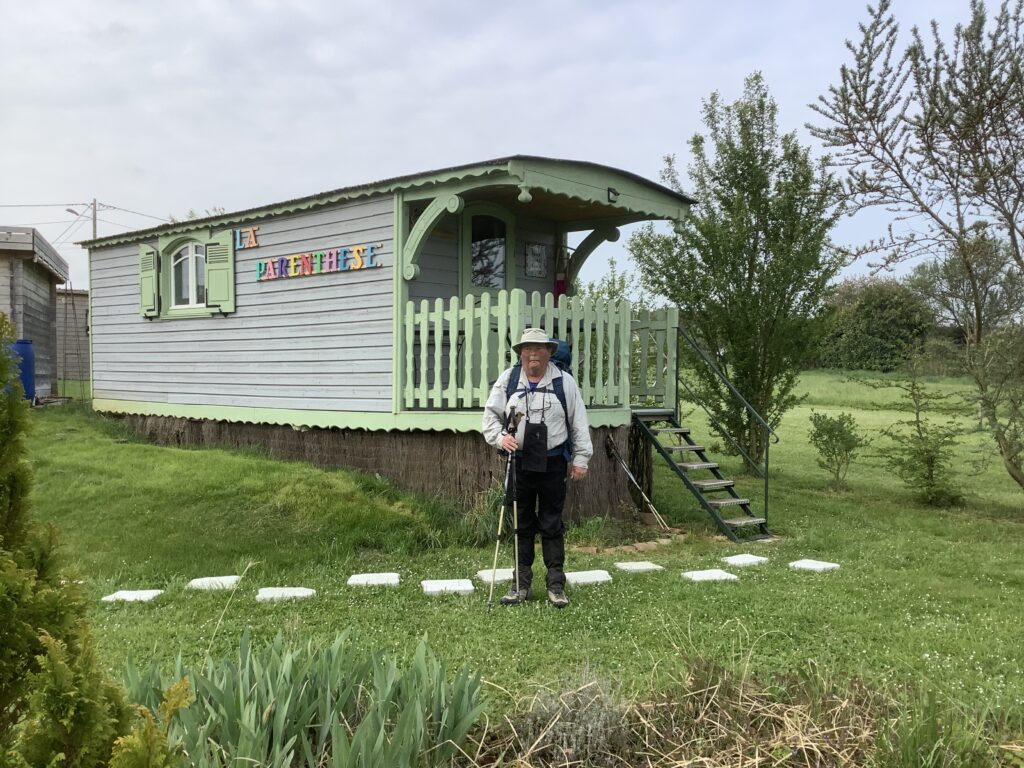
Leaving our cute compact accommodation in Villeret

On leaving Villeret we took a grassy track across the fields to the adjacent village several kilometres away to the south west, Montmorency Beaufort – the latter part of the name because it has a chateau, though it must have been hidden amongst the trees as we didn’t see it.
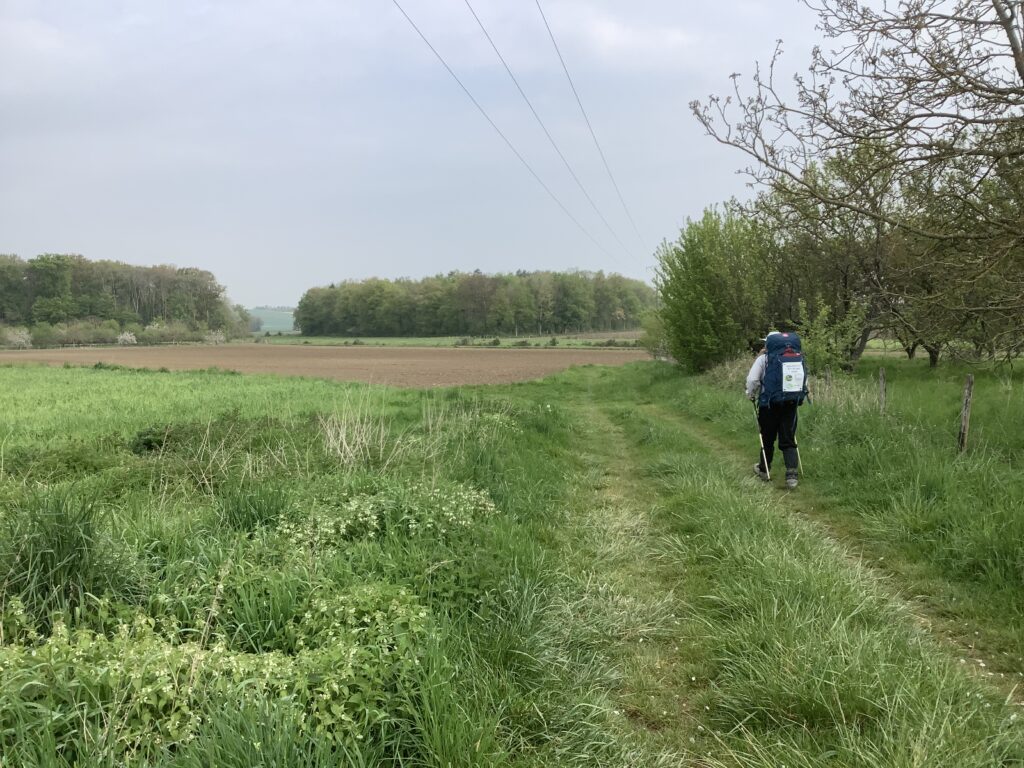
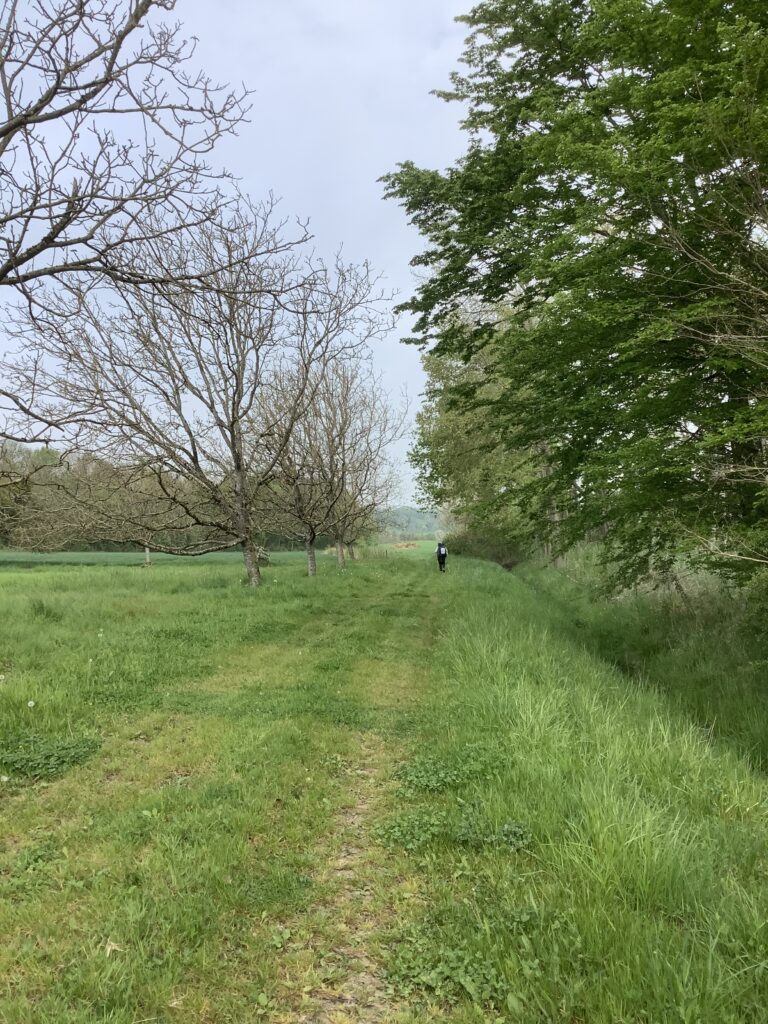
Leaving Villeret across the fields

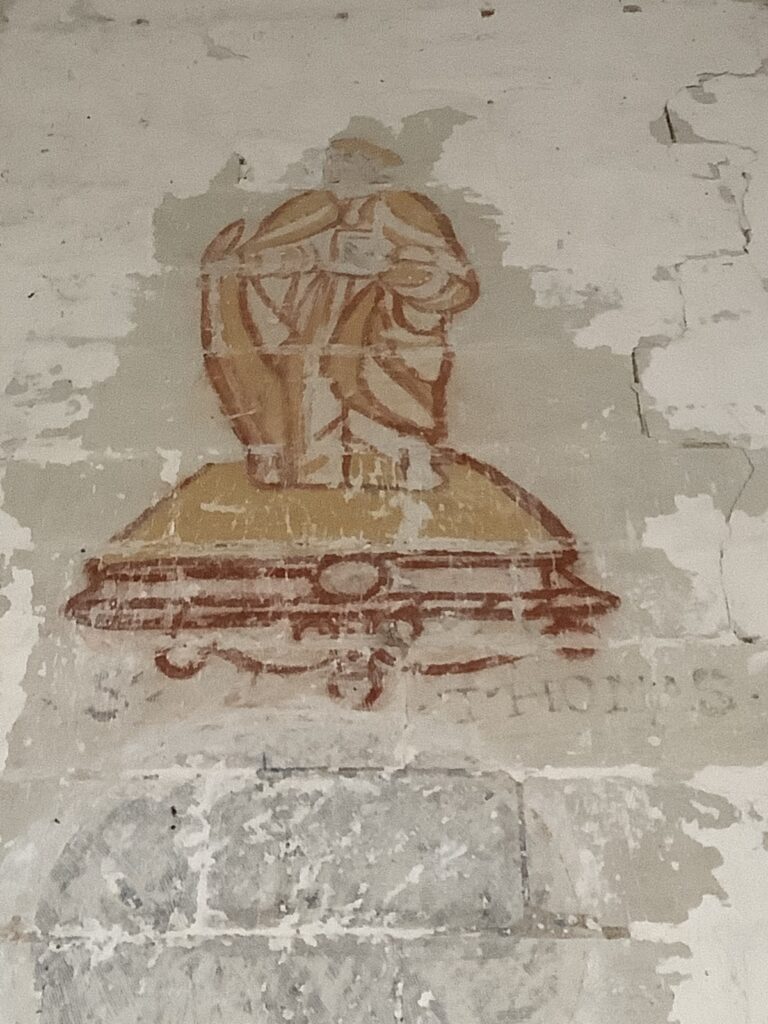
The church in Montmorency Beaufort is tucked in behind the Mairie and was open, though we had to grapple with a non-hinged door-sized fly screen and several steep steps down to get inside. Although the church is built of stone, there is a rather dilapidated wooden porch at the west end. Inside there were some interesting looking murals but no information on them in the leaflets provided about the history of the church.
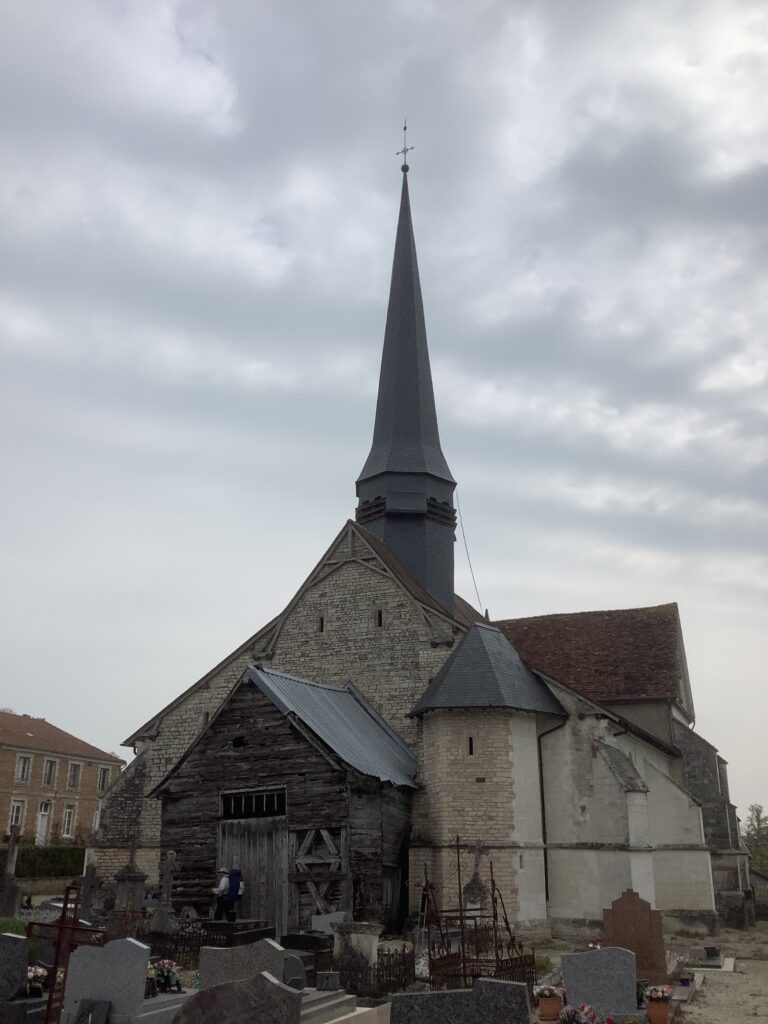
Eglise at Montmorency Beaufort
Mural of St Thomas at Montorency Beaufort

Today is polling day in the second round of the French Presidential elections, but there seemed to be almost no one around. However, as we left the church, carefully replacing the fly screen, we got into conversation with a woman in the churchyard who invited us to come with her to meet her son who speaks English.

So it was that we spent an hour with Annie and her son Laurent, whose passion is classic Lotus cars. We were shown several acquisitions in various states of restoration in the extensive sheds adjacent to an old timber framed farmhouse. It was fascinating hearing from an expert and enthusiast. Sadly, with most of the day’s walk still to be done we felt we had to turn down their kind offer of refreshments and instead get going.
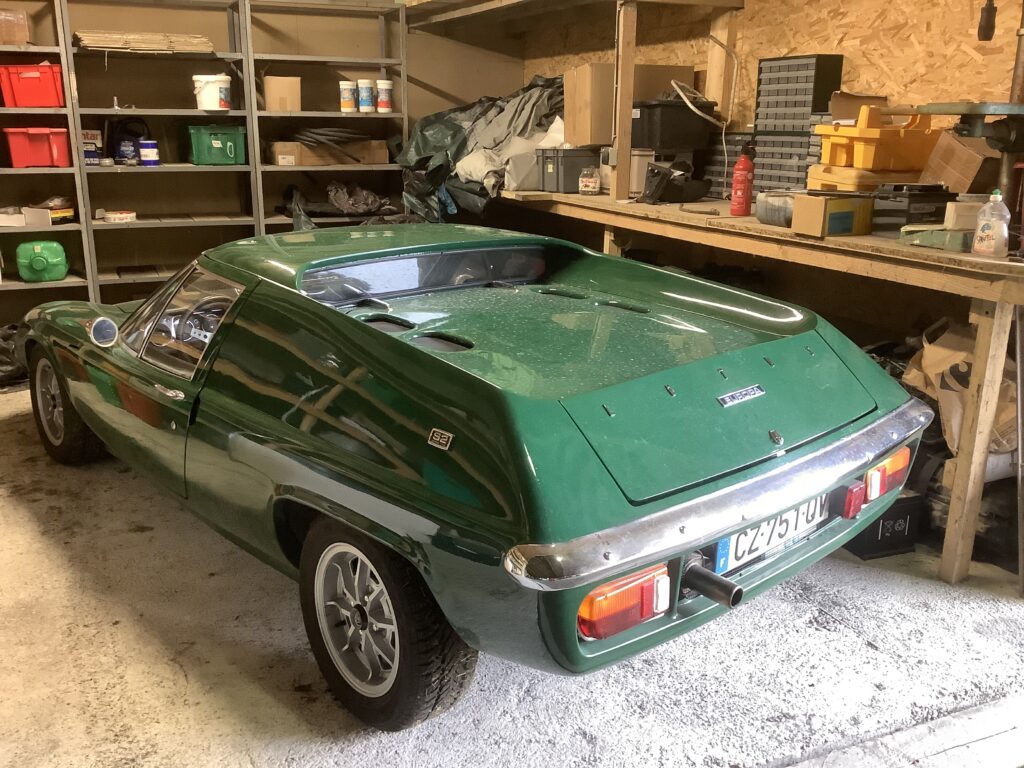
Laurent’s pride and joy

Much of our route onto Rosnay L’Hopital was along a minor road which, because it is straight, attracts speeding motorists. We’ve noticed that when there are no other cars around most drivers give us a wide berth, but it becomes a game of chicken if cars come in both directions at the same time, often with neither willing to slow down.
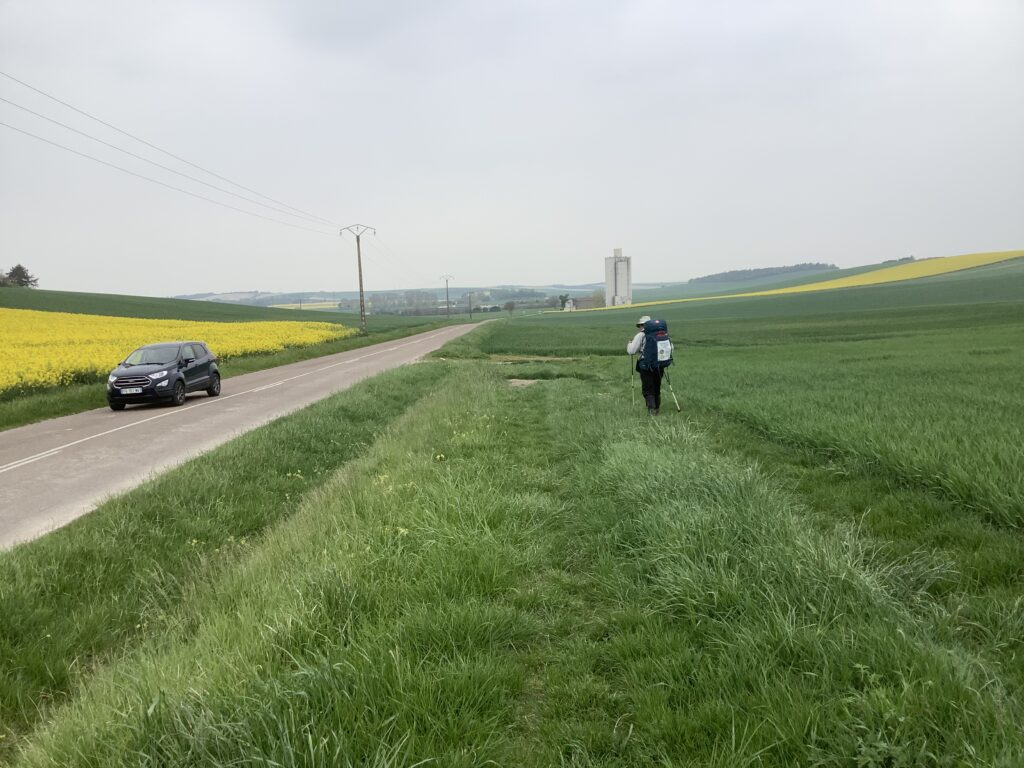
Brief respite from speeding motorists
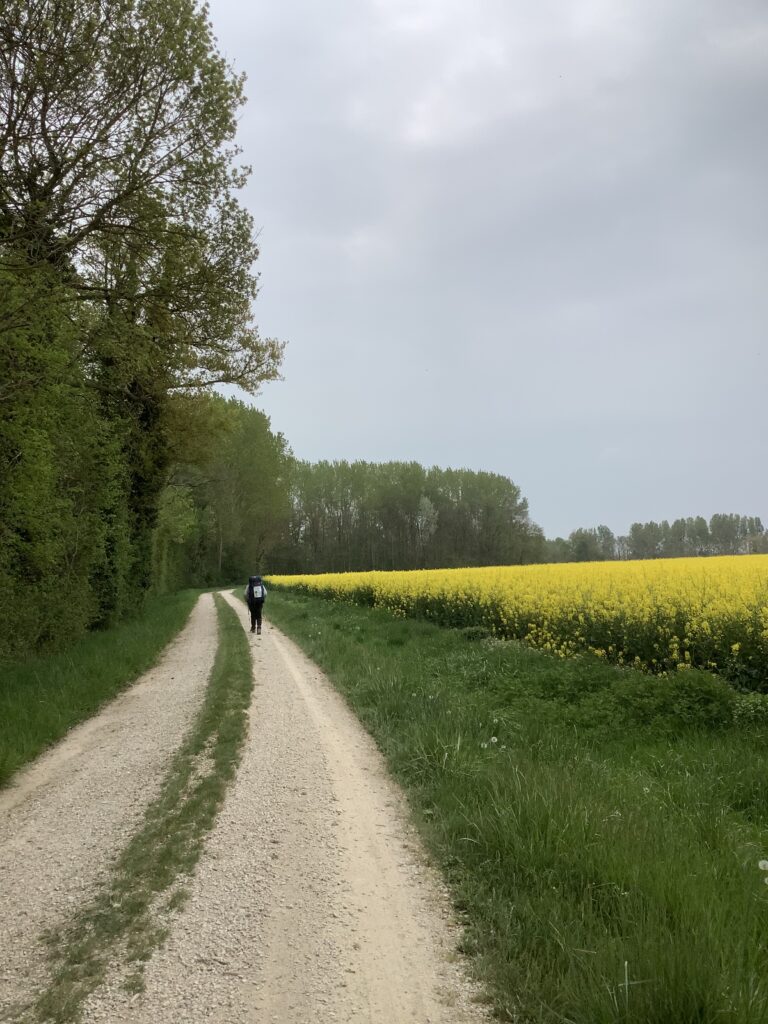
Taking refuge on a gravelled track into Rosnay l’Hopital

Fortunately, for the last kilometre or so the path took us away from the road and onto a gravelled track across fields, which was much more pleasant, with an abundance of wild flowers and birdsong, and an absence of lunatic drivers!
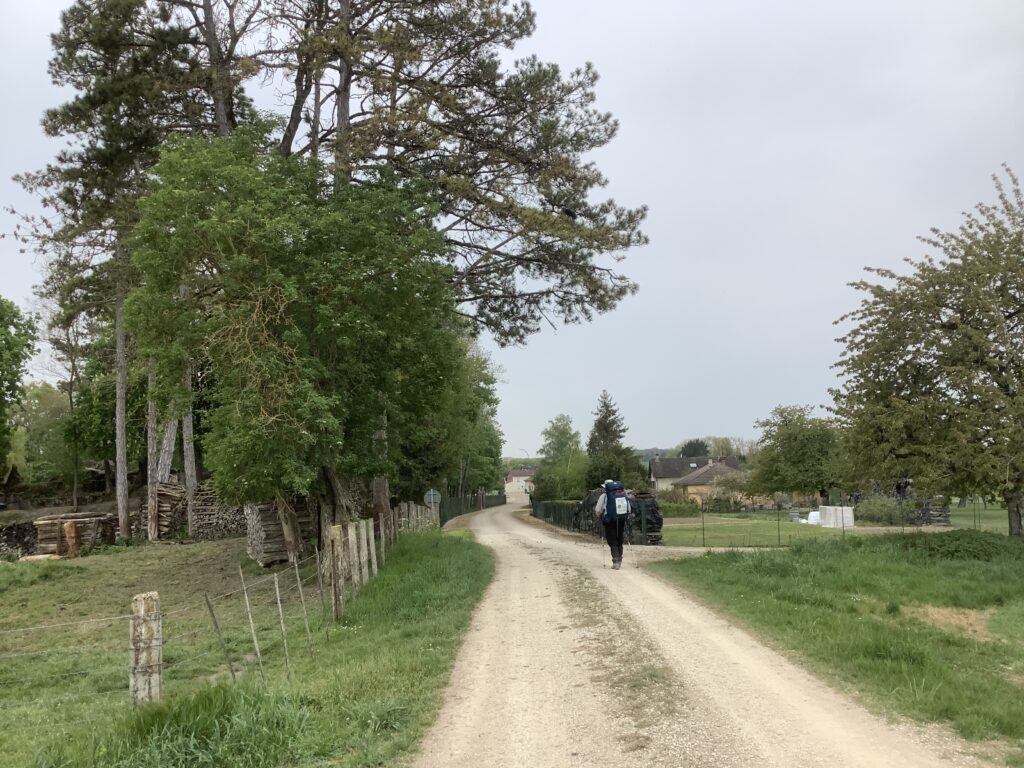
Entering Rosnay l’Hopital

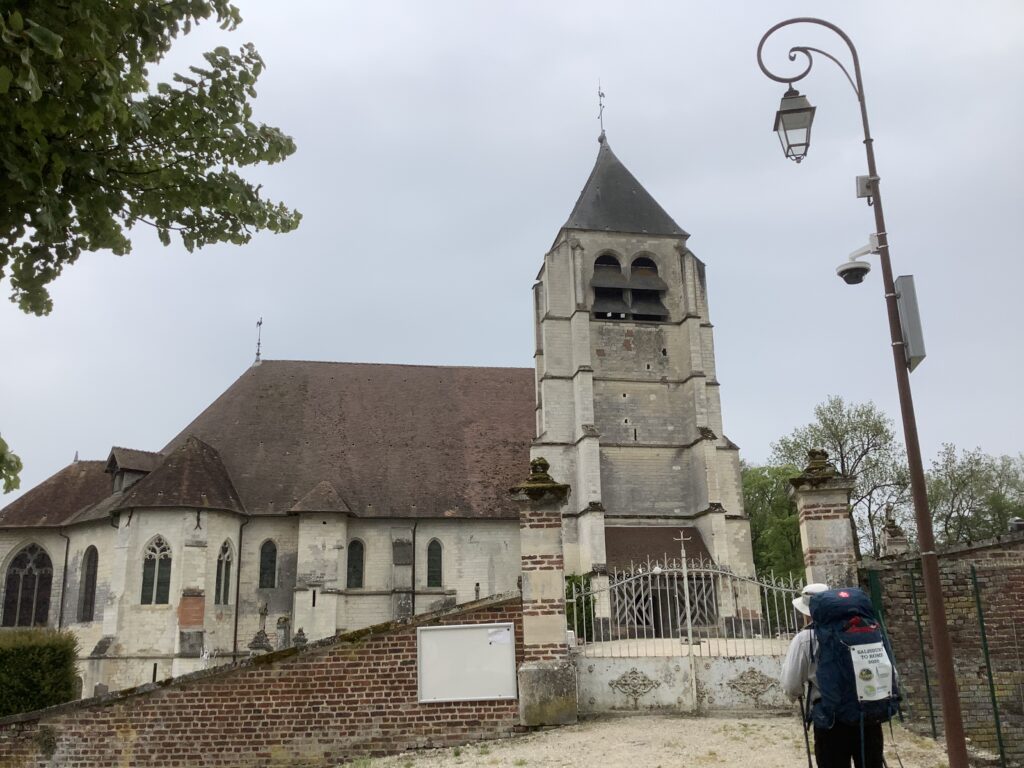
Apart from an attractive small chateau and its gardens, Rosnay l’Hopital has a church, the oldest part of which (the crypt) was built in around 1035. It is said to have been visited by Thomas of Canterbury (Becket) whilst he was living in exile in France after falling out with King Henry II over the primacy and privileges of the Church. The story is that he caused a spring of holy water to emerge here.
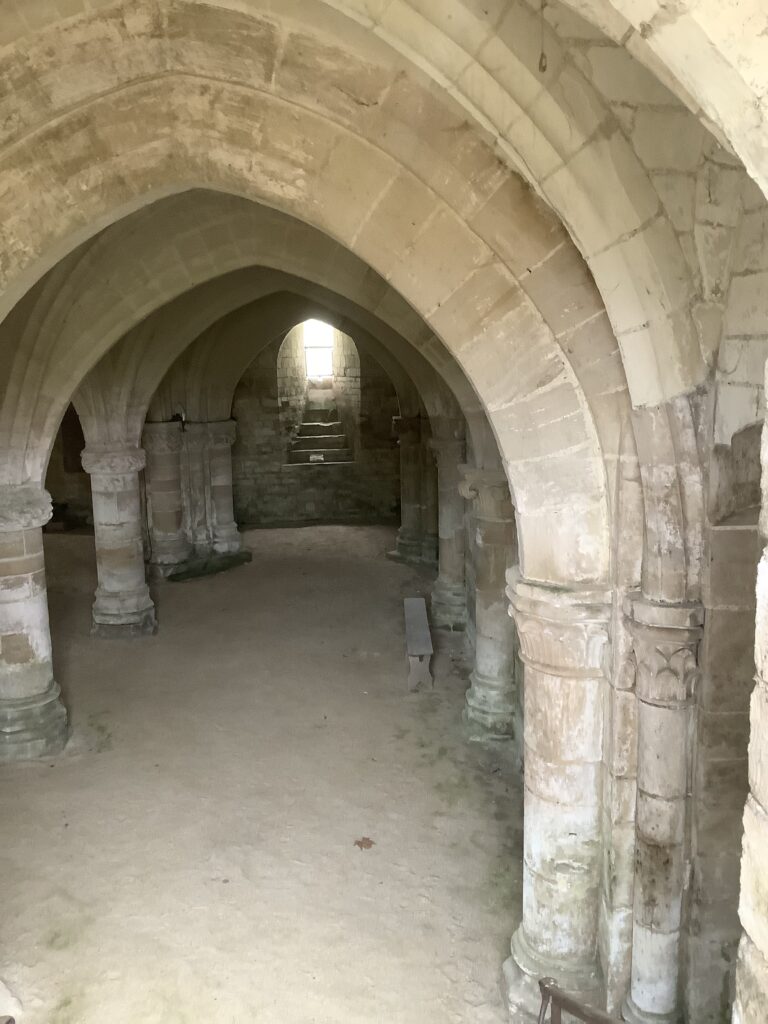
The second part of the church was built above the crypt in the 15th and 16th centuries. There was a notice in the church stating that the crypt was open between 1400 and 1800, but having sat on a bench outside the church to eat our lunch until after the appointed time there was still no sign of anyone with the key so we gave up and went on our way. A pity, since this was our third encounter with the history of Thomas a Becket: the first being of course at Canterbury, and the second at Wissant, where he departed France for the last time.
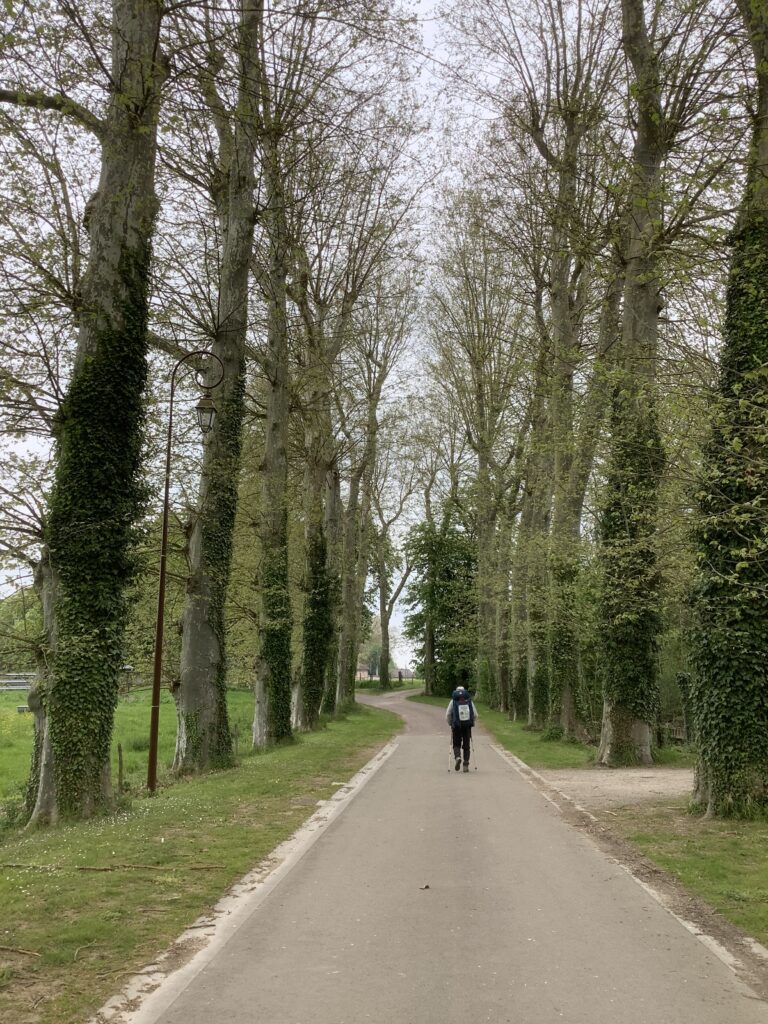
Down the road we walked through an avenue of beautiful mature plane trees coming into leaf, with a meadow of buttercups to one side, and then a field with Charolais cows and calves very keen to talk to Tom!
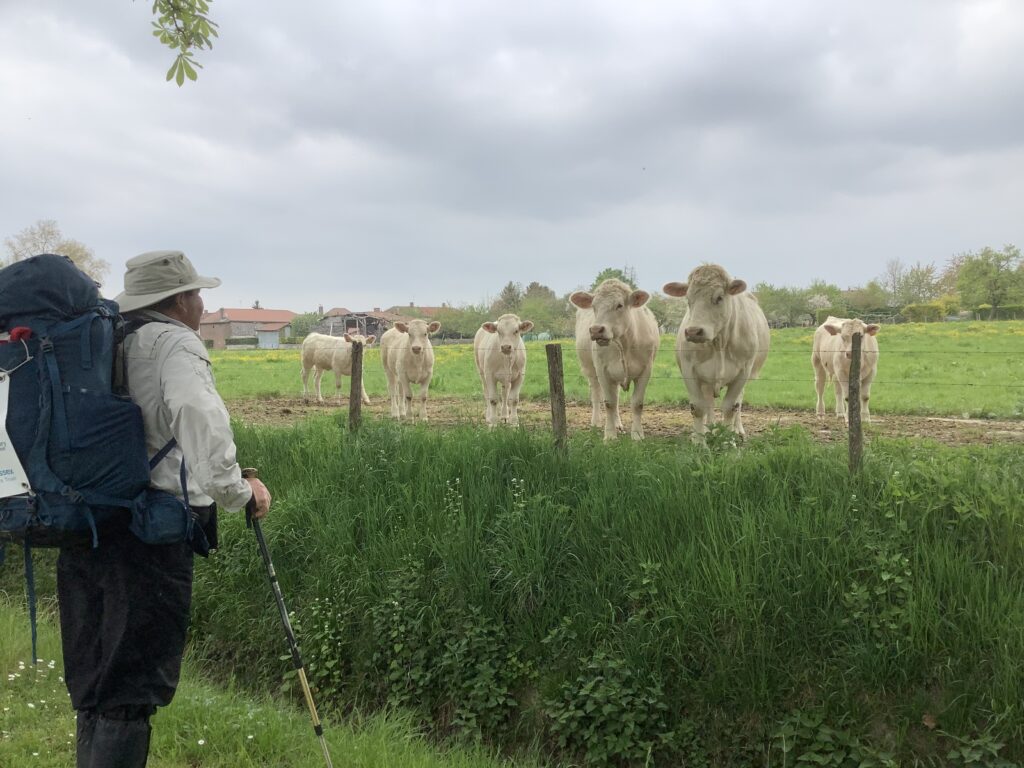
Tom talking to the Charolais in his best French!

From Rosnay we took a dirt track uphill onto a high chalk ridge giving magnificent views in all directions. How many more trees there are in the landscape here than there were further north. And of course everything is more in leaf as we are now several weeks further into spring. It is as if spring has accelerated as we’ve come further south.
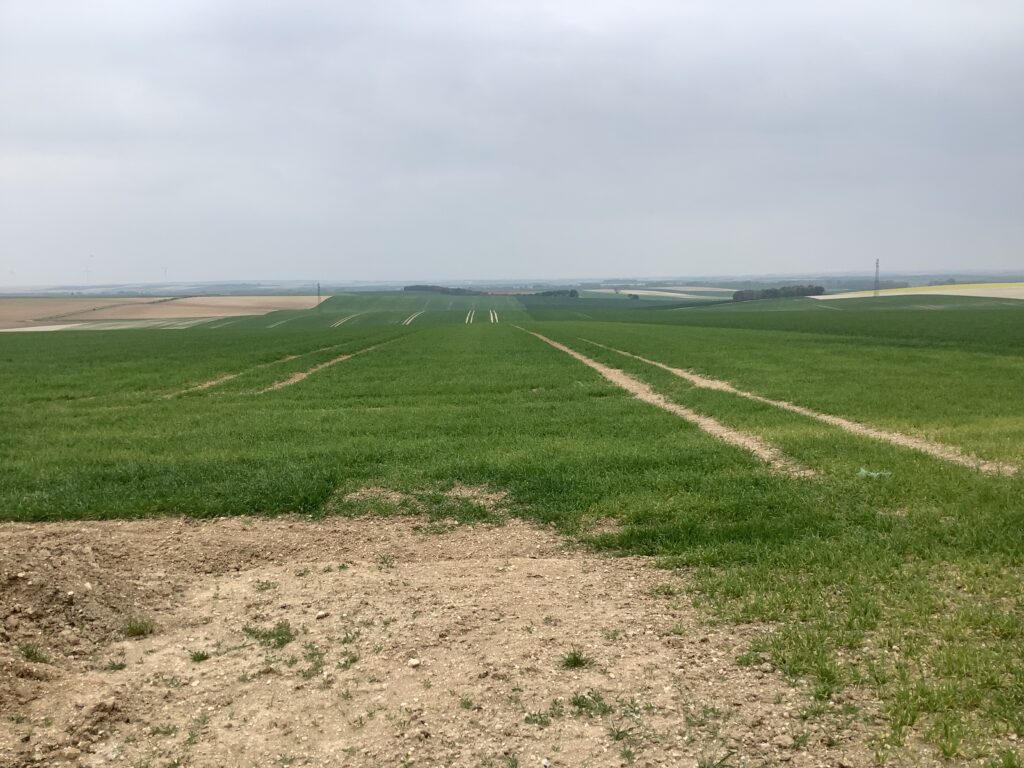
After several kilometres walking along the chalk ridge we’d climbed from Rosnay l’Hopital, we descended into Betignicourt.
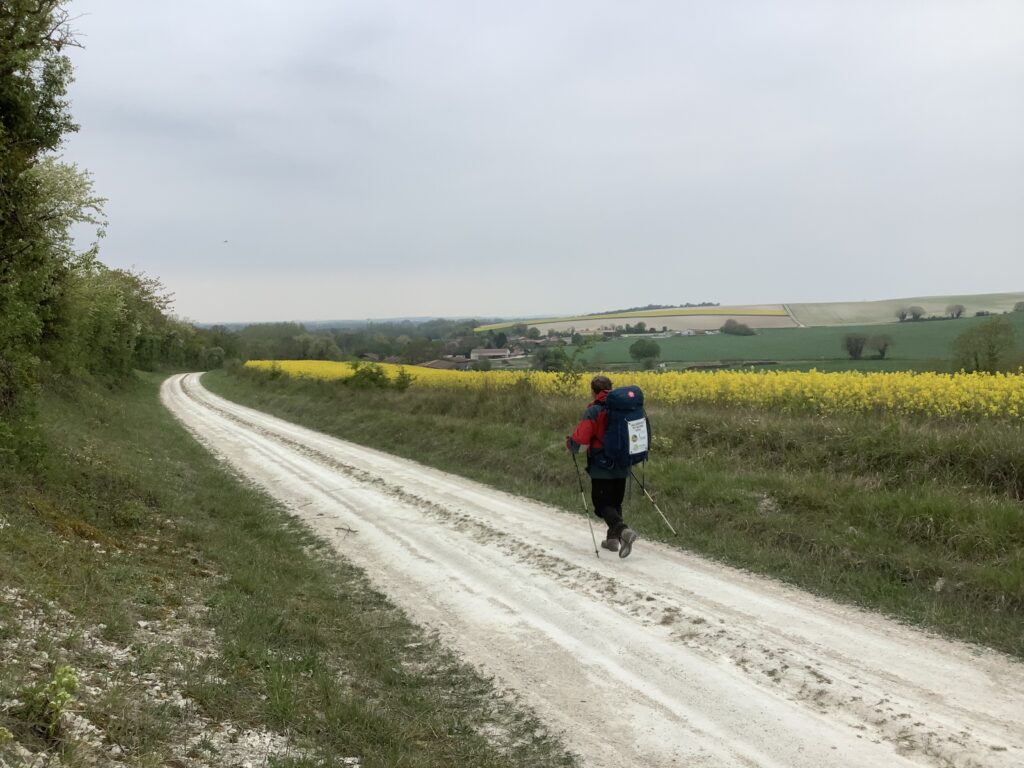
Rather than follow the circuitous VF route via Chalette sur Voire, we decided to take a short cut across the flood plain to Precy Saint Martin. Shortly we crossed the River Voire: a rather slow and uninteresting looking stream. Soon after we encountered a series of former gravel workings surrounded by a high chain-link fence. Several serious looking carp anglers were bivouaced along their margins with vehicles parked close by. Interestingly, most seemed to have British number plates: the first we’d seen for a long time.

Turning the corner we passed the entrance where there was a sign for Gigantica Carp Fishing. A later web search told us that this is a British owned business providing anglers with the opportunity to catch huge carp. The website shows several pictures of anglers with carp over 80lb and one extraordinary fish of 88lb 4oz! The British record carp when Tom was a child was just 44lb caught by his fishing hero Dick Walker in 1952.

We passed a wonderful sign advertising the arrival of fibre based broadband, brought by Mr Men. Must send that one to Robert who’s organising the superfast broadband in our village!
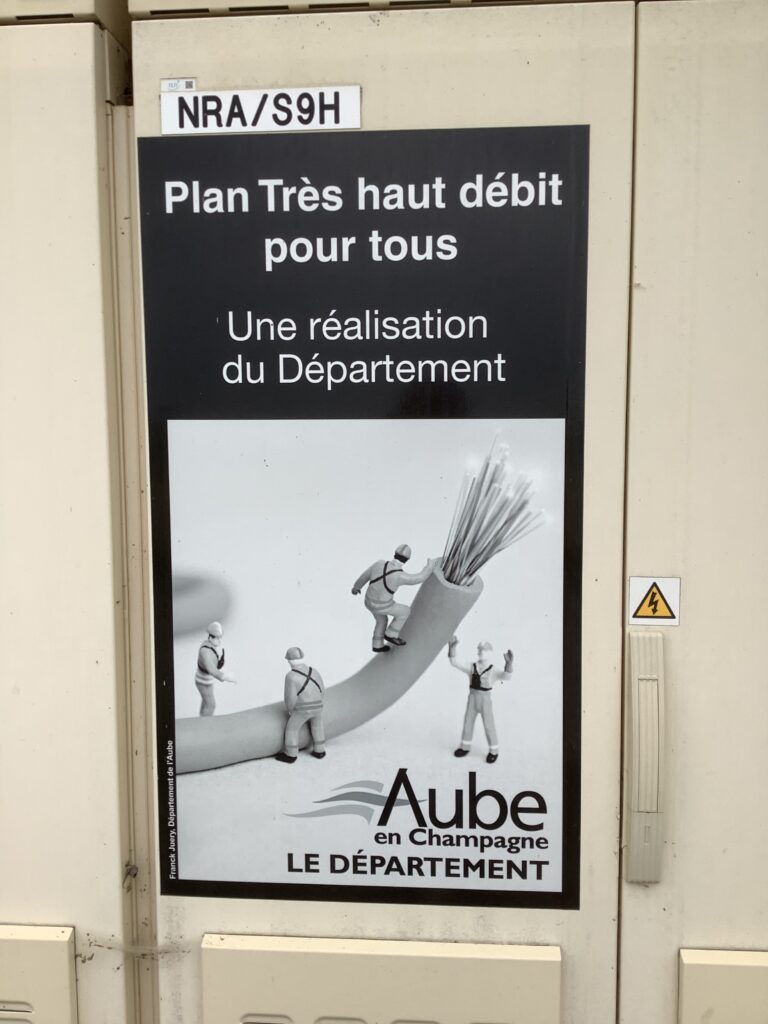

According to the signs we then crosssed the route of a Roman road connecting Boulogne with Lyon, but we could see no evidence of it. An enthusiastic Aube government official might have known better than we did.

The aerodrome shown on our maps turned out to be less military than civil with light planes taking off and landing as well as a prop powered parascender!
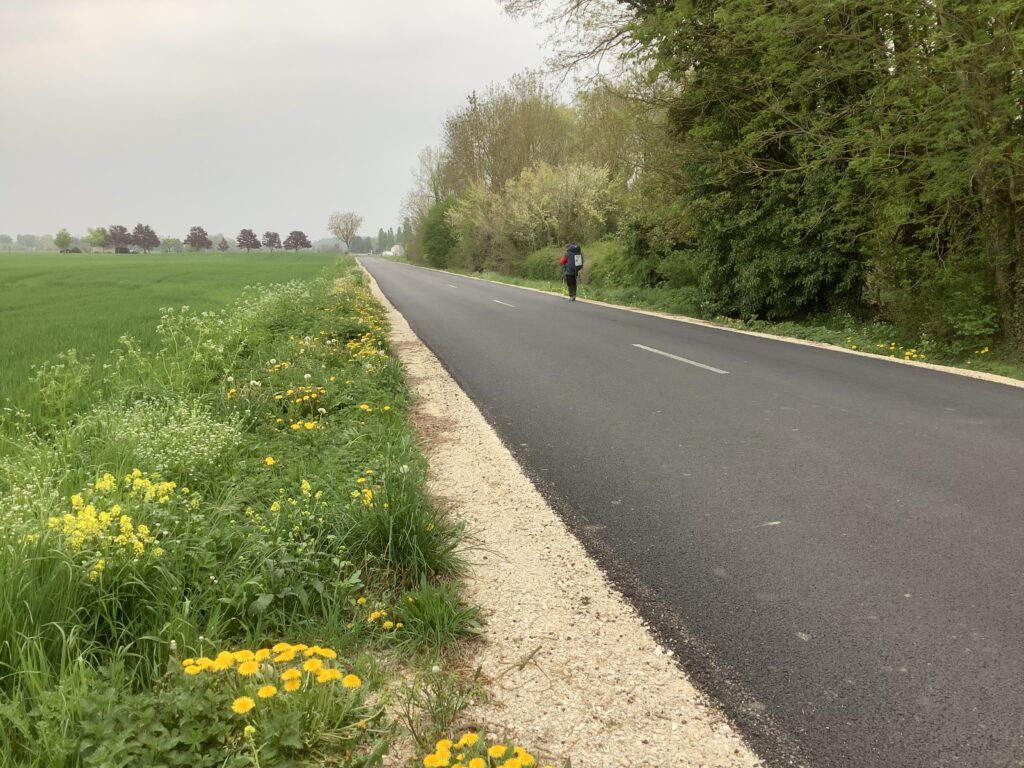
Trudging along the road towards the aerodrome – lovely wild flowers!

Then it began to rain. Despite a not-so-good forecast we’d succeeded in escaping the rain all day so far. Never mind, our destination wasn’t so far off, so on with the caghoules, heads down and on up the hill we plodded to Precy Saint Martin.

The Au Fil des Lacs, our lodging for the night, was easy to find and we welcomed a hot shower followed by beer and supper.

Highlight of the day? Well, it has to be the church at Rosnay L’Hopital, and the connection with Thomas a Becket again, despite the fact we couldn’t get into the crypt. However, meeting Laurent and Annie, his mother and the Lotuses in Montmorency Beaufort came a close second!

DAY 48 DROSNAY TO VILLERET

The morning sky was a little grey and the temperature had dropped overnight, with a forecast for possible showers during the day. Today’s walk was all about wooden churches – which were open and proudly part of a recognised tourist route, so completely different from what we’ve seen so far.

As we left our very comfortable overnight accommodation, our hosts for tonight happened to drive past and very kindly offered to take one or both of our packs in their car to save us carrying them all day. As we don’t have separate day packs we regretfully declined and headed up the road to look at Drosnay church which Matt assured us was well worth visiting as he’d been up there last night before supper.

Drosnay church with several French military graves
Inside the church at Drosnay

This, the Eglise Notre Dame de l’Assomption and the other nearby churches we saw today, are completely different from any of the stone churches we have so far passed. Drosnay’s was built in the 17th century, with a timber frame infilled with what looks very much like chalk cob of the kind many walls are made of where we live in Hampshire.

From the church we backtracked past our lodgings down the D55 to the village of Outines. Despite roadwalking it was not unpleasant.

Tom and Matt on the road from Drosnay to Outines

At Outines is another timber framed church, this time early 16th century, the oldest wood dating from 1512. The Eglise Saint Nicolas was built in much the same style as the church in Drosnay, and is regarded as one of the best examples in this region. It is noted for the wood shingles protecting the west end, and for its rose window which is rare in these churches.

Eglise St Nicolas, Outines
Inside Eglise St Nicolas – said to be modelled on a covered market

Outines itself contains many timber framed houses in varying states of repair, and is a very attractive village.

Timbered houses in Outines village

From Outines we struck out across farmland using a mixture of gravel tracks and grassy tracks around the fields. Although fields here are still large, there is noticeably more woodland than and more mixed agriculture than further north, though there is also evidence of crop spraying here too.

At the junction of paths we found two chairs on which to rest – more or less in the middle of nowhere, but very welcome. Nearby there were two small ponds, as well as ditches around the fields, suggesting that this land doesn’t drain well, though today it was pretty dry. There were animal tracks in the grass where something regularly travels to use one of the ponds but we couldn’t work out what it might be. Nearby there was a profusion of wild blue bugles in flower.

Wild blue bugles

In the next village of Bailly-le-Franc there was another lovely wooden church dedicated to Sainte-Croix-en-son-Exultation. This one was lighter as well as smaller than the church at Outines, and was built earlier too, in 1510. It is noted for the variety of roof angles and coverings, including roman tiles, slate, and chestnut shingles. Unfortunately the floor of the church was very damp, with green algae growing between the paving stones, probably due to rising damp.

Church at Bailly-le-Franc

A convenient seat outside the church suited our purposes for lunch, though afterwards we realised there was a picnic area a few hundred yards along the road! Matt produced some leaves of wild garlic to garnish his very healthy green salad, which Tom bravely tried, whilst we ate our usual bread and cheese with tomatoes and oranges. Fittingly, we learned that Matt’s rucksack was his grandfather’s. Alan was a very keen walker and loved going to the Lake District which wasn’t far from their home in Southport.

After a rest we walked on down the road, with large areas of woodland offering shade and birdsong, and some offroad walking on dirt tracks, to Lentilles.

Buttercup meadow on our way to Lentilles

The church in Lentilles was also built in 1512, and is considered one of the most typical examples of the champagne area’s wooden churches. A particular characteristic is that its steeple is twisted!

Inside, there is unusual diamond patterned woodwork above the nave which was rediscovered in 1970 when a later plaster ceiling was removed, and unusual small circular windows in the choir, some retaining their medieval glass.

From Lentilles we walked down the road to Villeret and our billet for the night, which wasn’t quite what we expected but turned out to be comfortable if compact.

The threatening sky didn’t catch us up until the evening!

As we went into Villeret we crossed the railway line again, and noted again that it looked little used. In fact we were later told that there is a plan to convert it into a cycle track, but for now it is illegal to walk along it – unfortunately, as it would have been our most direct route and, like canal paths, makes for easy level walking.

Having dropped off our bags at our accommodation, we went to have a look at the church, but found it closed. The church in Villeret is made of stone, and has large windows and impressive flying buttresses, but otherwise we discovered nothing about it.

At 5pm our host yesterday, Christophe, came to pick us up and return Matt to his car back in Drosnay. He either drove a roundabout route, or we had walked a long way today! As Matt needed to fill up with petrol we then drove to Montier en Der, and also bought more food to eke out the suppers for two left in the fridge by our hosts so that Matt could eat with us. It was about 30 minutes’ drive to find fuel and a supermarket, which reinforced our impression of the isolated living in small country villages, without public transport and many kilometres drive from supermarkets and other services. On the other hand, we have found internet services to be excellent even in isolated villages – unlike the poor service we have to put up with at home!

On the way back to Villeret we diverted to Giffaumont to have a look at Lac Der, famous for the mass migration of cranes which takes place in October. The lake is vast, and much used judging by the services on the lakeside, including rather bizarrely a casino! Tom was thrilled to see a number of swallows swooping around us.

Highlight of today? The pleasure of Matt’s company and the very interesting discussions we had about: politics in Europe, Climate Change, modern socio-economics, agriculture, environment, the dangers of social media and political disinformation, indeed disinformation generally…………can’t remember what else, but it was a very enjoyable day!


DAY 47 VITRY-LE-FRANCOIS TO DROSNAY

We woke to another fine day with just a slight chill in the wind. Our lodgings at the Hotel Au Bon Sejour had been very comfortable and the owners very kind and helpful. We were fortunate to have had a room at the back of the building overlooking the garden. It might have been a little noisier on the front. As we passed, we enjoyed another long sniff of the lovely lilac in the park opposite the hotel.

We set off via the boulangerie we’d spotted yesterday and bought made up bagette sandwiches for lunch. From the centre our route took us south east towards the river. In one of the parks we passed we were very surprised to see a couple sheep! Do they keep the daisies here for the sheep to graze?!

Sheep safely grazing!

Soon we came upon another WW1 cemetery containing the reburied bodies and remains of about 4000 French and 7 British soldiers who died in the nearby battles of the Marne, plus a small number of local men who died in WW2. As we learned yesterday, Vitry was at the centre of the first Battle of the Marne but, following the French victory, the town was about 60km behind the frontlines and became important for its several hospitals taking in those wounded on the battlefield.

Note that every cross is back-to-back with another cross

Just around the corner we started along a path beside the Marne river, where there is a developing problem with Japanese knotweed infesting the banks.

At Frignicourt, just south of Vitry, we crossed to the west side of the river Marne which we saw for the last time. One way or another we’ve been closely following the Marne for five days, since leaving the Champagne vineyards. It’s an interesting looking river and certainly worth considering for a canoeing trip.

Crossing the Marne

Our choice of route today and for the next two has been largely driven by the availability of accommodation. This means longer distances and the need to choose a more direct route than the official Via Francigena, and consequently more road walking.

From the Marne bridge we followed the busy D396 to Blaise-sous-Arzillieres, where we turned onto a track alongside the railway line. We considered walking down the service path for the railway line itself, given that the line seems very little used and it provides a direct route to where we needed to go. However, we didn’t wish to precipitate an incident, so decided better of it.

The end of the track necessitated crossing the railway and a field to get back onto the D56, which although tarmac was not busy and made very pleasant walking to Arzillieres Neuville. As we entered the village we noticed what looked like a small shrine just off the road. On closer inspection we saw that it was an enclosure around the spring of St Antoine.

Spring of St Antoine

In the village we climbed up to the church built on a hill spur overlooking the village, with views for many miles around. Sadly, as usual, the church was locked.

On the way out of the village we passed several old timber framed houses made of wattle and daub (or the French equivalent) which appear to be typical of this area. There were several that appeared to be in need of renovation!

After the short detour to see the church it was lunchtime, and we found a building with shade and somewhere to sit just outside the village, before continuing on along the road to the next village of Bussy.

On the road from Arzillieres Neuville to Bussy
Charolais cows and calves enjoying the spring sunshine

At Bussy we came across another water source adjacent to a bench in the shade of some trees, but decided it would be safer to use the tap in the churchyard to refill our water bottles.

Water source at Bussy

At this point Tom identified a track across fields to cut off a corner in the road to the next village of Gigny-aux-Bois. We were then back onto small quiet roads partly lined by woodland providing welcome shade from the heat of the afternoon.

The last stretch of the road to Drosnay took us past a small lake which, like almost all we have seen in the Marne valley, has private fishing and is ‘interdit au public’. However, as we were going to arrive too early at our billet we decided to spend a while lying on the grass next to the lake watching the coots and swans.

Just up the road a farmer was unloading cows and calves from a trailer to join others already out at grass. Interestingly, it was the calves which left the trailer first, leaving their mothers bellowing at them to come back, before they ran after their friends already out in the field.

Our billet turns out to be a renovated timbered building, and is very comfortable. We are delighted to be joined this evening by Julie’s cousin Matt who has driven over from Brussels to walk with us tomorrow, hopefully in better weather than he would have had on 01 April when it snowed!

Highlights of today? Siesta by the lake, and seeing Matt for the first time in several years.

DAY 46 REST DAY IN VITRY-LE-FRANCOIS

Although yesterday we felt very much in need of a day off, we haven’t felt as foot sore today as on some of our previous rest days, so maybe our feet are finally getting used to their daily pounding! A late start and leisurely breakfast probably helped too.

Our hotel is conveniently located just off the town centre adjacent to some lovely gardens with the Mairie across the other side. When we walk into town we walk past several heavily, or should we say headily, scented lilacs in full bloom and we linger to take it in.

Mairie at Vitry le Francois

The Mairie was able to stamp our pilgrim passports, which was as well because although the church was open there was no one there.

Collegiale Notre Dame de Vitry-le-Francois

The present collegiale (collegiate church) building was erected from 1629 onwards, like the town itself, at the behest of King Francois following the destruction of an earlier church. It therefore lacks the medieval stained glass of other nearby cathedrals, but perhaps makes up for that by its simple classical style, lightness and loftiness.

It stands on the east side of the main town square, la Place d’Armes, which is spacious and bounded on the other three sides by elegant 16th century houses with several restaurants at street level.

According to a couple of plaques around town, Vitry-le-Francois was important in the context of the first Battle of the Marne in 1914 because it lies between the two main areas of the fighting. The church was commandeered as a hospital for treating the wounded on both sides. The Mairie was initially the command centre of resistance to the German invasion, but that quickly turned to cooperation for the preservation of the town and protection of the population.

Northeast aspect of the cathedral

An earlier church building dating from the C12th (?), was destroyed by Louis VII when at war with Theobold II of Champagne over a dispute with the Pope. His army burned Vitry to the ground, including the church where 1500 residents had sought refuge.

This morning, all was peaceful and there was a market in full swing in the square. We were able to find a stall selling reading glasses to replace the pair Tom has been carrying around his neck and repeatedly catching in his rucksack strap – with the inevitable consequences. There is only so much you can do with surgical tape!

La Place d’Armes cleared after this morning’s market

Not content with just one replacement pair of reading glasses, we set off in search of another pair and found a fruit and vegetable market in the adjacent square. No glasses there, but we stocked up on oranges and tomatoes for the next few days’ lunches, before heading back out of the north gate (which we came past yesterday) to a supermarket just beyond. We are now well stocked up with bread, cheese, cold meat and reading glasses.

Chores done and lunchtime approaching we just needed to decide where to have lunch, and chose a restaurant on the main square looking towards the church. After enjoying delicious salads and a pichet of house rose, we were ready for a siesta back at our hotel!

Rest days are such a treat!

We spent the afternoon sleeping off lunch, cleaning boots and making various repairs to rucsacks and gaiters.

Highlight of the day? Well, lunch of course!

DAY 45 SAINT GERMAIN LA VILLE TO VITRY LE FRANCOIS

There are so many places called Vitry that is is essential to add the Le Francois bit so people know where you’re talking about! Wikipedia lists no less than 14 places called Vitry in 9 different Departements.

Our lodgings for the night at Les Perrieres were most comfortable, and throughly recommended to other VF pilgrims. The family were very friendly and hospitable, and our table d’hote (evening meal) was excellent, with the added advantage that we didn’t need to carry extra food or any bottles! Our hosts are retired farmers whose son is giving up on his father’s large scale chicken rearing due to high energy costs and going into hosting fields of photovoltaic panels. An agricultural practice we’re not sure we support as we still need food and most energy use takes place in cities, where you don’t seem to see either photovoltaic panels or wind turbines….but diversify they must to survive.

Les Perrieres with our bedroom window to the left

We set off again in bright sunshine but a cool breeze. We called in at the village church but, predictably, it was locked. Of interest, there were six Commonwealth War Graves tucked around the back of the church, being an entire bomber crew killed on 19th July 1944.

Our route for the day was to walk straight down the Canal Lateral a la Marne on the west bank towpath. This is the most direct route to Vitry: about 23 km, versus something like 36 km on the GR route. Our host Denis had warned that there might be “travaux” on the path, but we decided that if there was a problem we’d just find a way around or if necessary blag our way past the works. Sure enough we found access to the tow path partially barricaded but it was not sufficient to deter us – or a few locals.

Looking back to Saint Martin le Ville

It soon became clear that the towpath was being remade. The first few kilometres were very comfortable walking on a newly laid roadbase. The sun was shining, spring in full bloom and activity around us.

At the next village of Pogny we came across a memorial to a group of locals who lost their lives defending their two bridges, over the canal and the river Marne, on 19 June 1940 during the German invasion. We began to notice in Chalons that in this area there is more evidence of events during the Second World War, as contrasted with further north where it seemed to be the First World War which left a more lasting impact.

Just beyond Pogny we passed a large canal-side factory owned by Omya, an industrial minerals company producing calcium carbonate products from the chalk, for use in a variety of applications including pharmaceuticals, paints, plastics, etc. It looked as though their use of the canal had diminished, judging by the disused look of the loading shed.

At the next village Chausee sur Marne we caught up with the “travaux” where there was a man guarding the barrier in a gilet jaune. Further down the path we could see several lorries and clouds of dust. As there was a reasonable alternative, by crossing over the canal, walking through the village, and onwards along a country road to rejoin the canal two bridges further on at Ablancourt, we decided not have an argument but to take that option. It actually made a pleasant change from the canal path.

Rolling countryside on the alternative route – it could have been anywhere in southern England in May

Thereafter we found that the path had been tarmac-ed, but the top dressing hadn’t been adequately rolled, leaving the surface slightly sticky to walk on. However they’d left sufficient margin of road-base at the side to walk on which was fine.

Lunch and the non-stick margin!

We stopped for lunch, just short of Soulanges. Here we heard another cuckoo and Tom saw two Danica mayflies hatch from the canal! The 20th April would be very early for them at home, but here, further south, every aspect of spring seems to be earlier.

Further on the canal appeared to have been carved from the hillside, but there was also evidence of quarrying activity, some historical and some current. So emerged around the corner the huge quarrying and cement kilning complex of Ciments Calcia. We could see a large reverberatory furnace and an extensive processing complex. Just around the next corner the barge Jersey which we had seen squeezing into the lock at Chalons (see yesterday’s blog) was alongside the wharf and its cargo of pulverised coal was being unloaded into lorries, presumably for the cement works.

By mid afternoon, Julie was flagging so we stopped for some crunchy bar and water to boost her blood sugars and enthusiasm for the last stretch. We had seen stone markers at intervals all day, and assume they were marking the distance from Vitry as the numbers were going down, though we weren’t sure!

3kms – but to where?!

Tom was excited to see cow-parsley in flower – again, very early compared to when we would expect to see it at home.

On our approach to Vitry the canal crossed over La Saulx, a sizeable tributary of the Marne. According to our research, this canal was built between 1836 and 1846, and it is good to see it is still in use and providing an effective transport network across France and into Germany.

Aqueduct taking the canal over the river Saulx

Soon after this our branch of the canal ended on the edge of Vitry, the other branch heading off east eventually to join the Rhine waterways. We were shocked to see a noticeboard informing us that 4.4 million euros is being spent on making 23.8 kilometres of cycle track along the canal – a huge sum of money considering the poor quality of surfacing work we had just walked along, though the concept is excellent and we were pleased to see that the 40+ plane trees alongside this section of the canal had been wrapped in thick insulation to protect them from the machinery.

Protected plane trees awaiting workmen to complete the cycle track

The last section of the walk into town was along a tree lined track adjacent to a section of disused canal, and then we came into suburbs with profusions of daisies in place of grass!

Vitry as seen today is a relatively modern town, the earlier one having been razed to the ground and later rebuilt in 1545 at the behest of King Francis, after whom it is named in gratitude. Consequently, the town is spaciously laid out, with wide streets, lots of trees and public gardens.

North gate to Vitry le Francois

The rather grand northern gate would have made an impressive entrance route into the town, though today it serves as a roundabout for traffic turning west to go to Paris. Our billet for the night was the other side of town, adjacent to gardens and hopefully quiet as we intend to spend our rest day there tomorrow.

Highlights of today include seeing Tom’s first mayfly of the year, and enjoying the glorious spring weather.

DAY 44 CHALONS TO ST GERMAIN LA VILLE

Despite an early breakfast it took us some time to get going on account of the need to find and book accommodation through the next week. This stage is particularly difficult accommodation-wise and needed careful planning with some modification of our route.

Street art around Chalons centre

Leaving our hotel at about 1100, we headed for the city centre to pick up provisions, and get our Pilgrim Passports stamped at the Office de Tourisme (which was open!).

Freshly painted street art

Passing the Cathedral of St Etienne we saw that it was open too and decided to delay our departure a little longer. We were very glad we did. The medieval stained glass windows are truly stunning! As we went into the cathedral the windows in the south transept were in front of us, glowing in the morning sunlight, and in unison we exclaimed “wow” – they are that good. Unfortunately the ipad camera isn’t capable of picking up the intensity of colours, but in reality they are glowing oranges, reds and blues in huge windows.

Windows in the south transept – in reality they are much more intensely coloured but the ipad camera cannot pick that up!

As with many of the large churches and cathedrals in this area, this one was built in the late 1100s to early 1200s in romanesque and early gothic style, with simple soaring pillars supporting the fan vaulting and huge windows letting in lots if light, despite the equally huge stained glass windows adding luxuriant colour to the simple almost white stonework.

Looking east up the nave, with huge windows above

In one of the side chapels there is what is described as a roman font carved out of stone similar to Tournai stone, beautiful in its simplicity with interesting carvings around the sides.

Roman font in St Etienne cathedral Chalon en Champagne

There were also some very old gravestones which have been preserved as standing carvings, whilst those on the floors have sadly worn beyond recognition. The figures were originally outlined in lead.

The great and good of Chalons immortalised on their gravestones

It was almost lunchtime when we dragged ourselves out of the cathedral and started on our way. As we recrossed the canal a barge was squeezing through the lock with no more than 6 inches to spare each side and only just fitting its length within the lock gates. Some very skilful driving required!

On crossing the Marne bridge we learned that it had been destroyed several times during WW2 as each side sought to prevent the other from gaining advantage: first by the French to slow down the German invasion in 1940, and then in 1944 by the Germans to hamper the Allied advance. The current bridge was built in 1945.

From here, we followed the river Marne upstream walking along the eastern bank on a good, level path, with dappled shade from surrounding trees and a slight breeze.

Setting off upstream along the eastern bank of the mighty Marne

Having set off so late we were soon in need of our lunch, and found a suitable fallen tree trunk to sit on close to the river bank to enjoy our bought filled rolls. A nice change from our usual bread and cheese!

After several kilometres of walking we came out into fields on our landward side, again cultivating huge areas of arable crops. For some time we could see the taller buildings in Chalon behind us on our northern eastern horizon, with the cathedral particularly prominent.

The next few kilometres took us around several lakes which were being used for fishing and signed as out of bounds to the rest of us.

Out in the fields the farmers were busy tending their crops, and we saw a few walkers and cyclists out enjoying the glorious sunshine. One young man was walking the Camino, which still runs along the same route as our Via Francigena at this point. We stopped for a chat. It sounded like he’d passed the young Englishman from Northampton we’d met in Bruay. It was good to know he still going strong. Several other walkers wished us bon courage once they realised we were walking over 2000 kilometres to Rome!

Eventually we turned away from the river to follow a canal path which took us to Saint Germain la Ville, our destination for today. There were swathes of cowslips along the bank.

Barges pull this contraption to trigger opening of the lock gates
Barge heading for the lock after pulling the lever

We found our lodgings in a farmstead on the other side of the village, and were glad we had requested ‘table d’hote’ as we were given a very ample and delicious supper by our farming hosts.

DAY 43 MATOUGUES TO CHALONS-EN-CHAMPAGNE

Another fine morning welcomed the pilgrims, with just a tinge of patchy high cloud. How fortunate we are, but how long will it last?

With a relatively short day’s walk to Chalons we were a little later leaving than normal, but we enjoyed the lie in. We backtracked through the village to recross the Marne in order to find a ‘chemin’ route through the middle of the valley rather than following the busy D3 road.

On our way past the church in Matouges we found it, rather unusually, open, so we went inside. It seemed well used and well kept. We couldn’t find anything about its history or its dedication, though it looked likely to be pre-gothic in its simplicity and therefore relatively old.

Church at Matougues

Once back across the Marne we found our ‘chemin’ and began following it east.The dry track made for easy walking on the flat alluvial plain. Every now and again we passed a lake, presumably former gravel diggings but now clearly stocked with coarse fish and seemingly well used by anglers on this lovely Easter Monday.

Easy walking on the Marne flood plain

After a while we passed under the A26 motorway (known as the Autoroute des Anglais).

Au dessous de l’Autoroute des Anglais

Not long after the A26 we turned north up to the Canal Lateral a la Marne, to meet the Via Francigena route from Conde, then followed a very pleasant canal bank walk for most of the way to Chalons.

We meet the canal and the Via Francigena route again

The canal path forms part of a long distance cycle route from Paris to Prague, thanks to European funding, so we decided to walk in single file to avoid repeated requests to move aside to let cyclists pass. Some appeared to think walkers shouldn’t be there, despite signs advising them to look out for pietons!

Cowslips lining the canal path

At around lunchtime a Frenchman out for a walk stopped to ask about our pilgrimage so we took the opportunity to ask him if there were any seats further along the canal where we could eat our sandwiches. He directed us to the nearby village of Saint Martin where we would find seats adjacent to the church…which we did!

As we were about to cross the bridge into Saint Martin a man walking a small dog lost hold of its lead and it started to run off, but Julie quickly speared the loop in its lead with her Leki pole, bringing it up short! Then, just as we crossed the bridge into Saint Martin a red squirrel shot across our path and up a nearby tree. This time, Julie saw it too. The morning’s late start had clearly improved her reflexes!

Lunch outside the church in Saint Martin

Whilst eating our lunch we were thrilled to see not only house martins, but also a swallow – the first for 2022. How welcome they are, all the way from southern Africa! Tom thinks he normally expects to see his first hirundinid between the 9th and 12th April, so these are late! Is that because the migration route is further west via the Donana wetland in southwest Spain? Maybe one of our wildlife trust friends would have a view on this.

Easter Monday lunchtime canal cruise

On returning to the canal we realised we were already in sight of Chalons, where the canal and river Marne come close together and our route took us one block west to swap canal side for riverside walking until we came to the main western entry point into the city.

Chalons in sight further up the canal
Alongside the Marne river coming into Chalons
The mighty Marne river streaming through Chalons

Turning left into the city we soon saw the cathedral of St Etienne which was closed despite its website stating it was open. There were many other disappointed would-be visitors just in the short time we were there. Inside we might have seen the famously beautiful medieval stained glass windows, many dating from the 12th century.

Cathedral of St Etienne one of Chalons’ main attractions, closed!

However, outside the cathedral is an interesting war memorial, including a very long list of ‘morts pour la France’ during WW1, and also many who died in other conflicts such as Afghanistan. This is the first place we have seen memorials to those who died other than in WW1 or WW2, which may have something to do with the fact that there are military bases in this area.

Walking in into the city we were intrigued by notices adjacent to the drain covers, urging people not to throw or empty anything into the drains because it will end up in the river Marne! It doesn’t seem to deter the throwers of cigarette butts though.

Chalons has a large number of half timbered houses which are typical of this region. One of the most flamboyant examples is the tourist office – which was also closed, during a busy holiday period and the start of the main tourist season!

Fortunately, the other main church in Chalons, Notre Dame en Vaux, was open. The church was originally outside the city gates and an earlier building collapsed in the early 1100s. Due to several miracles taking place at the site money was raised to rebuild. What we see today is a mixture of romanesque and early gothic architecture with many richly coloured medieval stained glass windows (which unfortunately are not done justice by the ipad’s camera). The twin towers at the western end are very impressive, and had been visible from some distance out of Chalons, even though the church does not stand on high ground.

Notre Dame en Vaux
Inside Notre Dame en Vaux

Notre Dame en Vaux is recognised as a key destination for pilgrims travelling across Europe on the caminos to Santiago di Compostella and to Rome on the Via Francigena, and as such it has UNESCO status. Although there was no sign of a pilgrim stamp or anyone to do the stamping, there was a notice indicating where in Chalons we might be able to get our pilgrim passes stamped. Perhaps tomorrow when the national holiday is over………

or maybe not?

In the meantime, we still had a couple of hours to wait until we could get into our hotel (because today is a national holiday so reception was closed until 5pm) so there was nothing for it but to sit in the sun in the main square with a drink and a sweet crepe whilst watching the world go by.

The Mairie and cafes in Place du Marechal Foch

In fact, it was so pleasant that we returned later for supper, because all the other restaurants are closed, because it’s a holiday. No-one wants to eat of course, when it’s a holiday, just like no-one wants to visit the cathedral! It was still warm enough to sit outside in the sunshine for the evening – in mid April! But of course, we are now much further south, and getting on for a quarter of the distance from Canterbury to Rome. So we are making progress, but at a pace that is allowing us time to look, listen, and think about what is going on around us.

Day 42 VILLERS MARMARY TO MATOUGUES

We all slept very well after our degustation! The nearby peacocks, though, were confused by a bright full moon and screeched waking us at intervals during the night, though Rhyd told us he slept through this. We awoke to a view from our bedroom window of the sun shining onto the vineyards, turning their daytime dull brown into a blaze of gold.

After a sumptuous breakfast including pancakes and something very tasty a bit like lardy bread, plus freshly squeezed orange juice, we got packed up and set out in full sunshine in the cool of early morning. Our hosts Henri and Juliette had offered to transport our bags to Matougues, where her parents live. We thanked them but declined on grounds that it made packing rather complicated.


Leaving Le Clos Adnet at Villers Marmery

We retraced our steps back up the hill onto our path, and resumed contouring between vineyards below and woodland above, with wonderful long distance views southwards.

It seemed rather odd not to be attending an Easter church service, but there were simply none available on our route. So we thought about Easter and Tom sang ‘There is a green hill far away’ heartily instead.

A short walk through beech trees brought us out towards the end of the escarpment we had been following, and onto a high plateau with huge fields of arable crops stretching into the distance.

We gradually descended into the village of Billy le Grand, which is home to several more champagne houses. Although it was Easter Sunday today, the church didn’t seem like it had been open or used for some time, and certainly there’d been no Easter service. We found somewhere to sit for a short rest. Just over the fence a tiny dog with a tiny bark got very agitated about our presence, and kept bouncing on his hind legs to puff up its rather pathetic impact!

Crossing the plateau towards Billy le Grand
Church at Billy le Grand

The other side of Billy le Grand we rejoined the canal de l’Aisne a la Marne, initially following it on a parallel woodland track on the south side above the tow path. As the heat of the sun was building by now, the cooling shade of the trees was welcome.

At one point we came upon a swarm of Hawthorn flies, buzzing up and down with their long dangling legs in the lee of some trees. Their Latin name is Bibio marci, on account of the fact that they usually first emerge around St Mark’s Day, 26th April. These were a full nine days early, but then we are a good deal further south, and many other aspects of spring seem to be further advanced too.

At one of a series of locks raising the level of the canal we sat on a grassy bank for lunch, before Rhyd went bounding off towards Chalons-en-Champagne alone to get a train to Paris and an onwards overnight bus to Amsterdam to meet up with his girlfriend. We felt a bit bereft! It has been lovely to have Rhyd’s company, and to share this experience with him.

We had decided that, as the planned overnight stop at Conde sur Marne was impossible due to lack of accommodation, we may as well shorten the walk by heading more directly to our hotel in Matougues. So, we too set off southwards across the fields and away from the canal though at a more sedate pace! There is no bounding to be done with a full heavy rucksack!

Crossing farmland between the canal and Marne valley

As we came down into the Marne valley we walked between villages to reach a crossing point that would take us over the canal and river Marne into Matougues on the west bank.

Walking from Vraux to Jucigny

What looked like a short walk from Jucingy turned out to be several long kilometres across the Marne river floodplain in the full heat of afternoon, crossing first the canal and then a sequence of small bridges over dry or drying side streams of the main river. As so often at this stage of the day, it seemed to go on for ever!

At last – coming into Matougues!
River Marne at Matougues

Our hotel was the other side of town on a main road, but thankfully the rooms are at the back away from the road and therefore quiet. Unfortunately the hotel restaurant, and its reception, are closed on Sundays from lunchtime onwards so we had to find our way in through the coded car park gate and then find the night entrance to the rooms.

We had eventually persuaded the hotel to leave some cold beers and food in jars in our room as we are not able to drive miles to find a restaurant, as seems to be expected of the several other guests arriving this evening. We noticed a pizza dispensing machine up the road, but as our instructions from the hotel included not trying to get into the kitchen because it is alarmed, we decided not to bother with pizzas. Not the best evening meal we have had, but at least we aren’t going to bed hungry.

Highlight of the day? That has to go to breakfast, but walking through the woods above the vineyards in dappled sunshine came a close second.

DAY 41 REIMS TO VILLERS MARMERY

Off we set at an early hour from our central Reims billet with Rhyd in tow.

Leaving our hotel early in the morning

Actually he was bounding ahead, in search of somewhere to buy bananas. Eventually he found somewhere to buy not just bananas but enough additional supplies to keep a Welsh platoon on the march. So we followed him on with bananas dangling from his sack, past the Basilique de St Remy, where we should have turned off until we realised our mistake. We then decided to stop talking and focus on navigation.

What’s this on the floor? It says something about the Via Francigena

After finding our way to the south bank of the Canal de l’Aisne a la Marne we then settled down to walk in the right direction. A delightful towpath, albeit tarmac, seemed to be well used by walkers and cyclists out enjoying the unusually good holiday weekend weather. Thus, in dappled sunshine and a light headwind we knocked off the first seven or eight kilometres of the day.

Canal boat using the lock near St Remy

Just after we joined the tow path we passed the Jardin Intergenerationnel, which is a Reims city initiative set up in 2012 to encourage ‘seniors’ to share their knowledge of and respect for the natural environment with school children. Sadly, though it was Easter Saturday, no one appeared to be using or working in the gardens, but perhaps they are busier during the school term. Let’s hope. It’s great idea.

Every few kilometres there was a water fountain worked by an Archimedes screw handily placed beside the tow path for all those walkers and runners who might otherwise dehydrate. We made use of them to keep our bottles topped up.

Topping up the water bottles

Lunchtime found us at a lock which takes the canal over the La Vesle river near Sillery where there happened to be a convenient bench to sit and eat our rations in the warm spring sunshine watching the ducks go by.

Rhyd drying out his feet during the lunch break! He doesn’t realise just how like Julie’s brother that sort of behaviour is. They’ve never met each other, but they both share a dose of Harris genes.

At Sillery we left the tow path and headed east towards the valley side and the slopes covered in champagne vineyards. On the outskirts of the village we passed another French national necropole (WW1 cemetery) but couldn’t readily find our way into it so we paid our respects from a distance. This cemetery was built in 1923 and contains the bodies of 11,259 soldiers who had been temporarily buried behind the front lines during the Great War. We had thought we were now south of the wartime trenches, but in fact we have moved from the British and Commonwealth sector to the French sector of the Allied front line. The level of slaughter here was just as shocking as we have come across further north.

Recrossing the north/south motorway that we used to whizz along, we were quickly in amongst the vines and began to recognise some well known names. In between the large patches demarcated by recognisable names we could identify other small sections, presumably owned by individual growers. Some areas had been sprayed to kill off weeds, whilst others were marked as ‘biologique’ and had grass and dandelions growing amongst the vines. Strange that the ‘biologique’ (organic) should be growing immediately alongside that which isn’t.

Recrossing the A26
Home of Moet et Chandon champagne – Reims in the distance

An intriguing windmill on top of the hill turned out to be the home of the Mumm champagne family, with glorious views in every direction. Hmmm!

The ‘engins agricoles’ used in the vineyards to grub the soil/weeds along rows of vines, with the chassis sitting high enough to pass over the vines and the wheel span just right to work two rows at a time are quite extraordinary.

From Moet et Chandon and Mumm at Verzenay, we took a lovely track through the beech woods to contour around the hillside to the next village of Verzy, which should have been our destination for the day, but for lack of available accommodation.

Grape press in Verzy

On the way out of Verzy, Julie spotted a plaque outside a house explaining that it had been set up in December 1927 for the care of ‘les mutiles’ (presumably war wounded) and was later used as a children’s home. With the overwhelming numbers of war dead it is easy to forget that there were also huge numbers of men who survived but with significant physical and mental scars of war.

Home for disabled WW1 soldiers
Contouring through the woods from Verzy to Villers Marmery

Just before we arrived in Villers Marmery to find our accommodation we noticed what looked like a blocked up entrance into tne hillside with a notice about anti-phylloxera, a disease caused by an aphid imported from north America in the 1850s which decimated French vineyards. We asked our hosts about it later and they said that someone had lived there……..which didn’t quite make sense to us, but we’ve been unable to find out more.

A former hotel in Villers Marmary had closed so we found ourselves staying at a winery Le Clos Adnet where the family has set up a couple of very comfortable rooms to provide chambres d’hotes. When asking if they could provide walking pilgrims with supper too we were offered a ‘degustation’ with platters of cold meats and cheeses. The degustation involved trying the family’s brut champagne, followed by the rose, and concluding with the extra fin, by which time we were quite happy with eating an interesting variety of cold meats and cheeses, and with the world in general! Excellent champagne and a wonderful spread of food.

Le Clos Adnet

The highlight of today was the opportunity to spend time with Rhyd catching up on his and family news, and sharing this adventure with him.

DAY 40 REST DAY IN REIMS

Hurrah, another rest day! Our accommodation is a few hundred yards from the cathedral, which we can see out of our window, taking care not to fall over the third floor balustrade. The downside of being so central is that it was very noisy throughout the night – which provided as good an excuse as any for doing nothing much today.

Location of our hotel on the left

We are delighted to have been joined by Julie’s cousin Rhyd who arrived by train from London via Paris yesterday evening, and will walk with us for the next couple of days before going back to work.

We spent this morning working out how to get Rhyd back north on a train over Easter weekend, and we now have a plan. Next was a visit to the cathedral, first admiring the stunning carvings on the west front which have mostly been cleaned and restored since we were last here about five years ago. Julie particularly likes the beasts which make art of roof drainage!

Reims cathedral was founded in about 407, and rebuilt and extended between 1211 and 1280. The current building is a careful restoration of the 13th century building which was largely destroyed, along with much of the city, during the First World War.

Reims centre and cathedral the end of WW1

Miraculously, some the medieval stained glass survived, but at the east end there are several very attractive modern windows in abstract designs, leaving it to the viewer to interpret them as they will. Inside the cathedral is half light and airy, and half quite dark due to the stained glass windows, but overall it has a peaceful ambience.

Modern windows at the east end by Knoebel

Historically, Reims cathedral was very important as the place where many of the kings of France were crowned. Today, like Canterbury, it has a welcome desk for pilgrims arriving on the Via Francigena from Canterbury, and those arriving from further east on one of the Camino pilgrim routes to Compostella in northern Spain as the various routes converge at Reims. As well as logging where we had come from and where we were going, the welcomers checked whether we needed assistance with finding accommodation, which was reassuring. They even had a ‘tampon’ for stamping our pilgrim passports, which was just as well as the tourist office here knew nothing about them!

Modern windows by Knoebel in the Jean d’Arc chapel

A leisurely lunch just across the way from the cathedral then necessitated a siesta. When in France…most places close for a couple of hours over the lunch period anyway!

Being Good Friday, just before 3pm we returned to the cathedral to attend a Chemin de Croix (Way of the Cross) service. We weren’t sure what to expect, but with service sheets and over one hundred people around us who seemed to know what to do, we got by. The service took the form of a meditation on each of the stations of the cross, with readings from Mark’s Gospel. These were interwoven with writings of a person who had been the subject of sexual abuse as a child. It was very powerful and moving.

The rest of our afternoon was spent sorting out our accommodation over the next few days; a far from straightforward exercise, with some places having gone out of business since our guide books were written, and some already booked up. Other places are simply too far off our route to be viable options. And then there are other places that don’t provide meals on a Sunday evening. By the end of a long day’s walk any extra kilometres really count, as does carrying extra weight such as our suppers.

So, for the next week we have had to adjust several of our planned days to get to somewhere that has accommodation, taking into account that we are physically unable to walk more than 28 kms in a day, no matter what the problems with accommodation. Perhaps the sleeping bags and survival bags will get some use after all….though we hope not.