DAY 115 – CAMAIORE TO LUCCA

The front and terrace of the Villa Cavallini

Today’s start was unusual: it was downhill! After a steep zig-zag down the hairpin bends of the Villa Cavallini’s drive, it was then a gentle uphill path alongside the river to take us into Camaiore. Although the sun was shining warmly this morning it was quite cold in the shade and we needed our cagoules and woolly hats.

On entering Camaiore an advertising board invited pilgrims to visit the museum, but as it is only open from 1000-1200 it was too late for us with a long day’s walk ahead. When we arrived in the central piazza the church bells were ringing to call people to Sunday Mass but we were able to slip inside the church for a quick look before the service started. The Chiesa di Santa Maria Assunta originates from 1260, was rebuilt in the 13-14th centuries, and retains its simple stone facade with rose window and Greek cross above. Inside, the church has later alterations but it has retained a modest simplicity, which we liked.

Chiesa di Santa Maria Assunta with its rose window and Greek cross above the west door
Inside the Chiesa di Santa Maria Assunta before the start of Sunday morning Mass

Once clear of the town, the path followed the edge of woodland on the side of a valley, leading us gently upwards. We were just thinking it was time to stop for a rest when, there before us, was a bench placed for weary pilgrims! Nearby was a display about Siguric’s pilgrimage to and from Rome in 990-994.

Further on up the valley there was a steep, though relatively short, climb up to the village of Montemagno. At the last few metres we were bemused by a sign stuck onto the door of a derelict chapel asking pilgrims to ‘walk in a silent and respectful way since people live around us who want to rest in the morning’. The house opposite looked uninhabited, and only the very fittest of pilgrims would have had breath to spare for making a noise on such a steep hill. We have yet to meet a rowdy pilgrim!

The start of the climb up to Montemagno with the steep sting in the tail at the end
The notice asking pilgrims to keep quiet!

Perched on a col at 220m, the village of Montemagno has lovely views back down the valley towards Camaiore and beyond. As it was Sunday there were again many cyclists out enjoying the late autumn sunshine. They, like us, were pausing at the col to take breath and appreciate the views from the top of the steep climb.

View back towards Camaiore from Montemagno

Whilst the cyclists then descended with the cars into the next valley, our path continued to climb higher before taking us back down into a different valley and the village of Licetro. After contouring along the hillside for a while the path plunged steeply downhill again, into Vallone.

Netting spread out ready to collect the olives waiting to be shaken off the trees

At this point we had to decide whether to do another steep uphill and downhill via Gualdo, or take the easier option of walking along the road to Valpromaro. We opted to take the easier route to try to make up some time. The steep ups and downs by rough paths take a lot longer than contouring along a smooth tarmac road, as well as being harder on the knees and hips.

In the centre of Valpromaro we had the choice of three benches in the sun for our lunch stop, and chose the one furthest away from the busy through road. Adjacent was a very striking bronze statue commemorating the three young men from this small village who were lost in the First World War, including one declared missing, presumed dead, in 1925. What an exacerbated disaster that must have been for the grieving family who were stuck in limbo for 7 years after the end of the war.

A striking bronze figure depicting the moment of death on a war memorial in Valpromaro

Leaving Valpromaro we picked up our footpath again, climbing back up another hill to the pretty village of Piazzano. Here we found a bench in the sun to sit for a brief rest admiring the view over olive groves and valley below. Onwards through the village we liked an advent display in an alcove, though it was hard to believe it is the beginning of advent when it was so warm and sunny. We could then hear the hubbub of many voices and around a corner came upon what looked like a street party outside the church. We were tempted to stop and join in, but with many kilometres still to walk we said our greetings and pressed on.

Nativity scene in an alcove in Piazzano
Looking back to Piazzano and its extensive olive groves

Outside Piazzano we noticed that the cemetery had gravestones as we see them in churchyards at home rather than the rows of huge family vaults we’ve been seeing in Italy until now. Diverted by this observation we missed our turning off the road and had to turn back after a few hundred metres. Our VF app and the signs differed on where our route lay. We soon realised why: the off-road path shown by our app was very steep and badly eroded, so it was slow going to avoid sliding or falling over.

Piazzano cemetery with lovely views over the valley

At the bottom of the hill we joined another road in the valley and then followed it for the next 6 kilometres into Ponte San Pietro. Despite a 50kph speed limit most cars were going much faster and, as ever, some were reluctant to keep clear of us, so there was more stick waving and the occasional toot from an irritated driver worried about his car’s paintwork. Only once so far has there been contact between walking pole and car, and the motorist just carried on.

This part of the walk wasn’t very interesting as the adjacent stream had no fish in it and there were no views. However, we noticed that some of the newly built houses had adopted the use of ventilating bricks upstairs as we’d seen in storage barns, presumably for the same purpose.

One of several newer houses with ventilation bricks apparently in place of upstairs windows

At Ponte San Pietro we were able to walk along the top of a flood defence bund, giving us a better perspective on the land around us. The church clock struck four as we were passing. The sun was by now low in the sky and the temperature dropping. Further along the wall we took the road bridge across the River Serchio, and turned upstream to follow a wide and well used path beside the river. There were many runners, walkers, and dog-walkers out enjoying the last of the Sunday afternoon daylight.

Passing Ponte San Pietro along the flood wall
Looking back across the River Serchio to Ponte San Pietro
Walking up the River Serchio as the light fades

After about 3 kilometres, and with the sun having set, we turned away from the river and towards the centre of Lucca. We just managed to get into lit streets before it became so dark that we would have needed to pull out our torches. As usual, provision of pavements and safe crossings for pedestrians were patchy, but we made it safely to one of the city gates, the Porta San Donato. Once within the walls of the old city there was very little traffic allowed so we could concentrate on finding our accommodation, tucked away down a narrow paved street off the main shopping street.

Tom’s bootlace only just held out!

And so we have come to the end of this stage of our walk. We will have a much-needed rest day here in Lucca tomorrow before setting out on the two day journey home for a longer period of rest and recuperation.

With the completion of this, our fourth stage, our calculations indicate that we have walked 2006 km from Salisbury to Lucca, which is 82.89% of the total distance to Rome, leaving less than 20% to complete.

It’s been an interesting leg with contrasting landscapes: from Alpine mountains and foothills to the open plains of the Po Valley; the wooded hills and snowcapped mountains of the Apennines to the urbanised coastal plains of the Riviera della Versilia. We’ve visited some historic cities with magnificent cathedrals including: Vercelli, Pavia, Piacenza, Fidenza, Pontremoli and Lucca. We’ve also met some fascinating people along the way. There was Carla Morello, the ‘Young Farmer Girl’. There was the Frenchman with his lovely dog from La Rochelle who’d walked from Briancon to Rome and was on his way back home again. There was the Swiss Guard who, having completed his two years duty at the Vatican, was on his way home to Lucerne on foot. There was a young German chap who was travelling all over the world making use of a gap between jobs to walk from Aosta to Rome. There was the very fit looking young Spaniard from Valencia with his multicoloured washing-up sponge shoulder pads. Then there was Isabella Cavallini who has given up a career as a vet to pursue her passion in running the family estate and villa. We wish all of them and many others we’ve met well in their endeavours and adventures.

DAY 114 – MASSA TO CAMAIORE

We were given an excellent breakfast this morning, including scrambled eggs, ham and cheese, as well as an array of sweet foods and fruit, so we were well prepared for another long day of walking. The B&B Il Cuore was one of the best places we’ve stayed in – a very comfortable room and bed, tea with milk and charming people running it.

As it was Saturday morning the streets were quiet as we headed uphill out of the old town. We quickly found our way back to the Via Francigena route and almost immediately were faced with a steep climb up to the castle. Thank goodness for the scrambled egg!

Looking uphill towards the fort above Massa
Looking back down the hill we had just climbed up
The impressive hill fort above Massa

With yesterday’s rain having cleared the air, the views from the fort were extensive.


Once down the other side our route hugged the base of the hills before turning up the Montignoso valley. From there it was a steep but steady climb by tar road up to Metati Rossi. The route seemed popular with cyclists; all very respectful of we heavily laden walkers and each one greeted us enthusiastically as they passed. From the top we were blessed with fabulous views of the coast northwards beyond Massa and La Spezia into Liguria, and southwards to the Island of Elba, now visible on the horizon. Elba was, of course, where Napoleon Bonaparte was imprisoned in exile, and is not actually very far from Corsica, the island of his birth.

View over Massa and the densely populated coastal belt, looking north-west
Looking out south to Elba on the horizon

Almost all of today’s walk was along roads, some busier than others. Instead of taking the direct main road to Camiaore, the Via Francigena walking route took us up into the hills behind the coastal plain. The Saturday cyclists were out in force today, grinding their way up the hills and whizzing down the other side. We shared the grinding but there was no whizzing for us, just toe and knee bashing on the downhills.

Winding our way through olive groves

All around us there were extensive vineyards perched on impossible slopes and many, many acres of olive groves. The sound of chainsaws echoed around us as people were busy pruning olive trees and collecting wood before winter sets in. Little three wheeled Piaggio trucks were being used by old men to move logs, while the young men were out revving their motor-scooters.

Young and old men’s vehicles

At Ripa our route met the Versilia River: an interesting looking freestone stream with what looked looked like Ranunculus growing in it (the first we’d seen in Italy). Not long after we found a suitable riverside spot for lunch and relaxing in the warm sunshine. From there our route ran along the flood control bund past a string of yards processing large blocks of quarried marble. High up on the mountains behind we could make out several quarries, creating huge white scars and gaps in the hillside where rock has been removed.

One of several marble cutting yards with quarries on the hillside behind
Slabs of marble awaiting the diamond wire cutter in the foreground
Even the town’s statuary is made from pieces of marble

The next place of note was Pietrasanta. Here there are many small shops lining a long pedestrianised main street. A wide range of luxury items was for sale: including Persian carpets, designer clothing, and art works. There were several boutique hotels, which we take to mean they’re expensive and don’t need to advertise on booking.com’s website. We had the impression that Pietrasanta is relatively wealthy.

Pietrasanta’s main shopping street – the Christmas lights and Christmas tree are already set up

The early medieval church of the Misericordia was interesting in that it has two modern and rather amusing frescoes painted in 1993 by Fernando Botero. One depicts the gate to heaven and the other the gate to hell. They make a refreshing change from the more usual dark and stylised older church paintings we have seen.

La Porta del Paradiso by Botero
La Porta dell’Inferno by Botero

In the centre of Pietrasanta is the C13th Collegiate Church of San Martino. As we arrived a band was setting up to perform on its steps. However when we left the band began to move all their gear aside after the priest opened the big west doors in readiness for a funeral bier to be brought in. Evidently there had been some miscommunication somewhere along the line!

La Collegieta di San Martino in Pietrasanta is 13th century. The tower is ‘unfinished’ but to our eyes it is attractive left as undressed bricks
Inside the collegiate church in Pietrasanta

After leaving Pietrasanta we had one more small hill to get over, this time off-road on a narrow muddy and stony track, and then a short level walk past extensive market gardening poly-tunnels and glasshouses to get to our accommodation. The owner of our accommodation later told us that about 30 years ago this area had grown flowers commercially but for the last 20 years they have been producing vast quantities of vegetables. We were amazed to see courgettes still flowering!

Our billet was a family owned villa perched high on the hillside with views to the west and north-west across the coastal plain to the sea. The Villa Cavallini was originally built in the 17th century. In 1938 it was acquired by one Eng Lt Cdr Verginio Cavallini, who was one of the principal naval architects responsible for designing submarines for the Italian Navy in the First World War. He was a significant innovator, developing the first double hulled boats. So successful were they that his designs were still being used in WW2. Some of his design drawings are on display in the villa. His great granddaughter, Isabella, has swapped a career as a vet in Verona to take on the daunting task of running the villa as an agriturismo B&B business using a wide range of produce from the estate, including olives, fruit, vegetables and herbs. She is also an excellent cook!

Approaching Villa Cavallini perched on the hillside ahead

We were given an delicious tasting menu of local dishes for our supper, most of which was produced on the estate. Isabella’s wine recommendation of a Tuscan bolgheri was an excellent choice. Pilgrimage doesn’t have to be all sackcloth and bare feet!

DAY 113 – SARZANA TO MASSA

Last night’s accommodation was not one of the best. The room was very cramped, the water was barely hot enough for a shower, and the sound-proofing was so poor that Tom had to bang on the wall around midnight to get the person adjacent to turn down the sound on their TV. Breakfast was advertised for 0800, which was after we wanted to have left, but when it came to it breakfast started at 0715…so we had two breakfasts as we’d eaten our own muesli and milk first!

Albergo La Villetta in Sarzana

We made an early start, passing by the impressive castello on our way out of town. As it didn’t open until 1000 there was no question of spending time looking around it as we had a long day’s walk ahead of us.

Although our guide to the VF stated today’s walk was on the level, we started by climbing up a steep cobbled road to another castello about 1km outside of Sarzana. Again, because we had a long day’s walk in prospect, we didn’t stop to explore this castello either, but carried on over the hill and down into the next valley.

Down in the valley we initially followed an irrigation channel, but the route then took us uphill and through a sequence of villages. Apart from the occasional barking dog they were very quiet and not particularly interesting. We noticed that many of the irrigation channels we walked along today were infested with huge bamboos, and in some places an attempt had been made to clear them.

The canale Lunense

Today, for the first time, Tom spotted fish in several of the canals. He thinks they were chub. He also noticed a coypu swimming towards us, and then a second coypu following. Avid readers will recall that we first saw coypu several weeks ago, but they were too far away to see clearly. Today’s came within about 6 feet before getting nervous and swimming to the other side of the canal.

By about 1015 the forecast rain arrived, lightly at first but then heavier and persistent for the rest of the day. We would probably have enjoyed the walking and scenery more than we did if the weather had been better, but we did get a sense of the lushness and fertility of this area.

Vines still in leaf further south and nearer sea level

We decided to detour from the official Via Francigena route to walk right down to the sea near Luni, the ancient port from which medieval pilgrims embarked for Santiago de Compostella.

At 1243 precisely we touched the Mediterranean thereby completing an important milestone – having crossed the continent of Europe on foot, from Wissant on the French Channel coast!

The final step to complete the crossing of the Europe

Having detoured to the coast we also decided to walk along the coast road to Massa di Marina rather than going back uphill to rejoin the VF, which would have added kilometres and climbing to an already long day. We hoped to have sea views, but in fact the seafront was heavily developed, and much of it blocked by one ‘proprieta privata’ after another.

Part way along the road we stopped under the awning of a bakery to put on our waterproof trousers and were very touched when, as we were leaving, a woman dashed out and thrust a bag of warm focaccia into Julie’s hands, saying it was ‘on the house’. We later stood in the undercover carpark of a block of flats to munch a couple of slices to keep us going.

Looking towards the mouth if the Magra river and Luni, the historical departure port for pilgrims heading to Santiago de Compostella

The rest of the day was a long slog along a very busy road following the coast southwards. At Marina di Carrera we attempted to check out the yacht marina but were told to “go!” by an officious security guard and misdirected by someone else in the port office who had seemed to be more helpful. Once it was obvious we’d missed any opportunity to visit the yacht basin we headed into a cafe for a warming drink and torte con marmolata before trudging onwards in the rain.

Containers being railroaded away from the commercial port at Marina di Carrera

Massa is about 3kms inland and uphill all the way, though not steeply. It was just an uninteresting trudge, made bearable by having a pavement all the way so we didn’t have to worry about the traffic. There is an extensive industrial area surrounding the old city, with many large factories. There is an extensive Baker Hughes plant which is probably quite a big employer. Quite what they make here is not clear but it is an American oil industry service company. Next door was a substantial plant producing polished marble, which was discharging sediment-laden waste water directly into the river!

Waste water from a marble polishing business discharging to the river
An old steamroller in dire need of some TLC!

We found our B&B located in the old city centre not far from the cathedral, and received a warm welcome – in every way: with a cup of tea, hot radiators to dry wet clothes on, hot showers, and a restaurant booked for supper. And the restaurant was excellent!

Mixed fish carpaccio antipasto – both beautifully presented and delicious!
We arrived too late to visit the duomo

We can’t complain about one wet day in what is supposed to be one of the wettest months of the year, but today was not very enjoyable, except for one of the best meals we’ve had in Italy so far and being in a very comfortable billet. However we can now claim that we’ve crossed Europe on foot!

Massa’s old centre looks interesting but we’re not going to have time to explore it on this visit.

DAY 112 – AULLA TO SARZANA

We dined well in the hotel restaurant Demy last night, and our room was very comfortable. This morning we woke to thick fog with an autumn chill in the air. Today we had two mountains to climb, with more than 400m of ascent, taking the direct route to Sanzana. According to the VF route description we were promised the first sight of the Mediterranean.

We set out at 0740 walking back through the town centre where we’d been yesterday afternoon.

The Hotel Demy

Last night we had crossed the bridge over the main river Marga for the views. This morning we crossed a tributary of the river, with ghostly views up and downstream in the fog.

We were almost immediately into a steep climb up out of the valley, for the start of the day’s first mountain. However the going under foot was good and the climb, though sustained, was at least steady.

At around 250m in height we emerged above the fog to clear views of the mountains and a sea of white fog completely hiding Aulla from sight, though we could hear the traffic far below.

A little further on we came to the first fortified village of the day, Bibola, perched on top of a hill with commanding views over the valley, still shrouded in fog.

Bibola perched on top of a hill with its ruined castle
Occasionally our path was on the sunny side of the hills, but mostly we were in shade

A little further along we met another pilgrim: a young man from Chartres who is a professional cook looking to experience Italian food along the way. He, like us, has not been overly impressed with Italian food since he started walking the Via Francigena from Aosta. Benjamin told us that on our rest day, when it rained in Filetto, he had been crossing the Passo della Cisa in rain, sleet, and snow. We were very glad we had come through the pass earlier in better weather.

Vecchietto village looking back towards the Apennines

In the next village, Vecchietto, we were so engrossed in conversation that we took the wrong path. Fortunately a kind man stopped us, checked we intended to follow the Via Francigena, and then led us back up the street to the turning we should have taken. The path led us upwards through olive groves, with lovely views back down the valley.

For the next couple of hours we climbed on up through woodland on variable tracks: some good and some potential ankle-twisters requiring care and intense concentration. We were amused by one of the more unusual route markers…and bemused as to how it got there. Usually the red and white painted markers are on trees, rocks, or wooden signposts.

An unusual place for a VF route marker!

At 1203 we had our first glimpse of the Mediterranean, verified by Tom getting out his binoculars to be sure we weren’t mistaking a line of haze for sea on the horizon. So, we are close to achieving another significant milestone by walking across Europe, from the English Channel/La Manche to the Mediterranean.

Our first view of the Mediterranean and the inlet of La Spezia top right

As we were unable to find anywhere comfortable to sit for lunch we continued walking until we got to the village of Ponzano Superiore. Just outside the village there was a flat grassy area in an olive grove in the sunshine which was perfect to sit and enjoy the distant sea views. It was so warm during the middle of the day today that we wished we’d been walking in shorts rather than the long trousers we swapped to wearing a couple of days ago.

Ponzano Superiore from the path above
A train enthusiast’s garden ornament?
16 young men from this small village died in WW1

Although the official VF route swung out of the village almost immediately, there was an attempt to engage visitors with a life-like tableau in the wash house below the village. Unfortunately there was no explanatory information with the display so we don’t know when the wash house was last in use.

Looking back to Ponzano Superiore and its olive groves

Below the village we wound our way past olive groves, vineyards and vegetable gardens, before climbing another smaller hill topped by the ruined Castello della Brina which dates from the 11th century and has extensive commanding views over the valley below.

View from Castello della Brinsa

On our way off the hillside Tom was particularly interested in a quarry restoration project, reminding him of his days working on mine closure planning for RioTinto.

Once down to the valley bottom much of the route into Sarzana followed an irrigation channel. It was easy level walking, until the last urban stretch along busy roads when we were back to flapping our walking poles at motorists coming too close for comfort.

Spotting for fish in an irrigation channel

The centre of Sarzana contains many old buildings, narrow paved streets, and a wide range of shops. What a contrast with Aulla, so we infer that Sarzana was not a target of heavy WW2 bombing. It was busy when we arrived late afternoon, with many people sitting outside cafes despite it being late November. The only irritation was canned music being broadcast in the streets, perhaps to encourage Black Friday shoppers.

Whilst we were passing we dropped in to have a look at the cathedral, which was in almost total darkness. It was so dark we couldn’t find a slot machine to switch on the lights! There was a light switch to illuminate the famous painted cross by Master Guglielmo, though it only lasted a couple of minutes before timing out.

Having found shops to replenish our lunch stock we headed to our accommodation just outside of the old part of the city.

DAY 111 – FILETTO (VILLAFRANCA) TO AULLA

We’re back to getting up early and setting out soon after dawn. Rather than a miserable coffee and brioche in a cafe we breakfasted on a good bowl of muesli with orange juice and a cup of tea in our room. This sets us up better for walking all day. The wind had dropped overnight and it was a crisp and misty autumn morning, with distant views of the mountaintops, now snow-capped, emerging out of the mist.

Walking through smallholdings outside Filetto in early morning mist
Distant views of the snow-capped mountains – the first snow of the year following yesterday’s precipitation

After a short stretch walking through smallholdings and then along a minor road we were back onto a track between stone walls, much the same as when we came into Filetto two days ago. It was noticeable how many more leaves have come down in the strong winds and rain yesterday. There were a fair number of green leaves and twiggy debris on the ground today.

Further on as we descended into a gully we could hear the sound of flowing water. It sounded like quite a lot and, being aware we had at least one stream to ford today, we feared the worst. As we rounded the corner we were much relieved to see a footbridge, even though the wooden deck was slippery with frost.

A woodland track brought us to more smallholdings, and a friendly donkey which was very dusty from rolling in the mud, as they do. We were intrigued by the fact that as we approached, both the dog and donkey were very exercised about our presence, but as soon as the owner greeted us they both settled down and the donkey allowed us to pat some of the dust out of its coat. It reminded Julie of her family’s donkey, Patrick, who had a very close relationship with the family dog – they used to play chase, which was hilarious to watch as each tried to outwit and outmanoeuvre the other.

At the first village of the day, Virgoletta, we got a better view of the snowy mountain tops, now glinting in the early morning sunshine against a clear blue sky. Looking at the snow level we reckoned that the Passo della Cisa was probably in snow too, and were glad we had come through earlier, before the snow had arrived.

Virgoletta is another fortified village standing proud on a hilltop, and it looked like it would have been very difficult to penetrate it against the wishes of its inhabitants. Our path passed below its impressive walls, rather than through its streets, taking us past the wash house – something we’ve not seen for a while, since leaving France.

Virgoletta’s impressive defensive walls

Two local women, wearing orange hazard trousers, were clearing away the leaves. We had a brief conversation with them about where we’d come from and that we’re heading for Rome, and they confirmed that yesterday’s was the first snow of this winter. They wished us well, expressing concern that we should be at home for Christmas!

Virgoletta’s wash house

Just up the hill there was a sign for a Roman fort (Castro Romano) but no indication how far away it was and our guide neither marked nor mentioned it, so we walked on without investigating further. Back up onto higher ground we had another good view across frosty vineyards to the snowy mountains on the horizon.

For the next hour or so our path followed a woodland track, up, along and down again. The going underfoot was rough, with loose stones half hidden by fallen leaves, just waiting to trip us up. By now the sun was fully up and showing off the glorious colours of the remaining leaves on the trees.

We had noticed that some parts of the track looked man-made, and this was confirmed by a noticeboard stating that we were walking on a track that was paved and used by pilgrims and traders in medieval times. It is an amazing feeling to know that you’re walking in the footsteps of people who passed the same way hundreds of years ago.

Medieval track between Virgoletta and Fornoli

At Fornoli the path detoured to avoid taking us through the village, which seemed a bit inhospitable as it involved a steep downhill slither followed by a climb back up on the other side of a stream. At the top we had our last glimpse of the snow-capped mountains until we reached Aulla, the views from now onwards being along the Magra river valley.

Scrambling up into the bottom of Fornoli, before turning away and heading on southwards

Above Fornoli the path took us through a pastoral scene we’ve not encountered so far this side of the Apennines, with cattle grazing on open sylvan pastures, before we were plunged back into extensive deciduous woodland.

The first grazing cattle we’ve seen for a while

This section of the path was very treacherous. It was very steep, very slippery, and deeply gouged out by motorbikes, leaving nowhere much to place walking boots with any grip. Unfortunately, just as he was thinking how much he dislikes walking on greasy mud, Tom went for a pearler, rucksack and all. Fortunately he wasn’t hurt, though he’d worried he might have damaged one of his Lecki poles. Eventually we reached the bottom, and the ground levelled off, much to our relief.

A field in the sunshine, sitting under an oak tree, provided a perfect lunch spot and we were able to relax in the warmth of the sun. On checking our emails, we learned the very sad news that our friend John had died late last night. Our thoughts and prayers are with his wife Maureen and their family.

Sitting under an oak tree in the warm sunshine thinking of John and Maureen

A little further along we joined a road and were quickly walking through the urban sprawl outside Aulla, and then into Aulla itself. As we have found so often with Italian towns, there is very little provision for pedestrians, leaving us very much at the mercy of speeding drivers reluctant to give a wide enough berth to allow us to feel safe. There was more stick waving needed!

Once in Aulla it was immediately noticeable that the buildings are all modern. Aulla was heavily bombed during WW2 by the Allied Forces trying to dislodge the Germans. There was also an important munitions factory which needed to be put out of action. Apart from a castle overlooking the town and a former monastery there was nothing much left. It seemed to us that the opportunity to rebuild was not as well used as it might have been, in that instead of piazzas with trees with overlooking cafes or anything pedestrian friendly, there are long rows of shops interspersed with ugly apartment blocks overlooking busy roads. On the other hand, places like Plymouth and Southampton are not exemplars of good quality post-war rebuilding either because there was not the money, and perhaps no one anticipated how ubiquitous car use would become.

Abbazia di San Caprasio
Magra river looking upstream, Aulla’s apartment blocks on the true left bank with the mountains behind reflecting the setting sunlight

Today’s highlight was the wonderful views of the snow-clad Apennine mountains bathed in sunlight, but there was sad news about John.

DAY 110 – REST DAY IN FILETTO (VILLAFRANCA)

We enjoyed the luxury of a lie-in this morning, after a night of heavy rain and strong winds which swirled around the small enclosed courtyard outside our window. Today was very cold, with a northerly wind blowing down off the mountains, and intermittent showers of rain. We were glad it has been a rest day and we didn’t need to go far.

Our room is tucked away where the light is on, and looks over a small enclosed courtyard – all the flying freeholds/leaseholds in these old buildings must be a conveyancer’s nightmare!

Although our accommodation was advertised as a B&B we found that we had to take a coupon to a cafe/bar 300m down the road to get breakfast. As always, they were doing a brisk trade in espressos for people just popping in for their mid-morning caffeine top-up, plus older people nursing a cup of coffee and/or glass of prosecco for a longer conversation. Breakfast over, we went back to our room to get the laundry done and drying, just missing another short sharp shower.

Another shower approaching from the mountains to the north

Laundry done we went in search of lunch and a supermarket to buy items for breakfast and lunch tomorrow. That involved going back down the hill into Villafranca centre, a not very lively place with few shops and spartan cafe/bars offering little in the way of lunches. We managed to find a bar selling filled focaccia and slices of pizza, and sat inside watching Denmark play Tunisia in the football World Cup. TVs are always on in bars and restaurants here, usually with crooning pop stars, but today it was football instead.

Borgo Mezzo in Filetto – we liked the flying buttresses between the houses

The only place nearby open for supper was also offering only pizzas, but they were thin and tasty, and we can probably use the carbohydrate for walking tomorrow. It has been a pleasantly lazy day, which we sorely needed as the next 5 days will include some longer walks which are all described as ‘challenging’ in our guide.

Piazza with last night’s excellent restaurant in the corner

DAY 109 – PONTREMOLI TO VILLAFRANCA IN LUNINGIANA

Today was a relatively short walk to Villafranca in Luningiana as we had opted to split an exceptionally long stage of 34 kilometres into two more manageable days, enabling us to enjoy the walking and take in the sights and scenery. Nonetheless we started out early because heavy rain and winds were forecast for late afternoon, this time consistently by several forecasters.

Leaving Pontremoli centre via the reconstructed medieval Ponte del Giubileo. Was this the bridge which trembled?
View upriver from Pontremoli with the rising sun lighting up the mountains

From the historic centre we set out over the river by the Ponte del Giubileo (jubilee bridge), with a quick check for a trout. Sadly there were none. Many of the rivers we have crossed recently look like good freestone trout streams, but we haven’t seen any fish anywhere in the Apennines. Perhaps this is the consequence of over exploitation. Certainly we’ve noticed a paucity of bird life. Given the numbers of hunters we’ve seen we’ve a good idea of the reason for that.

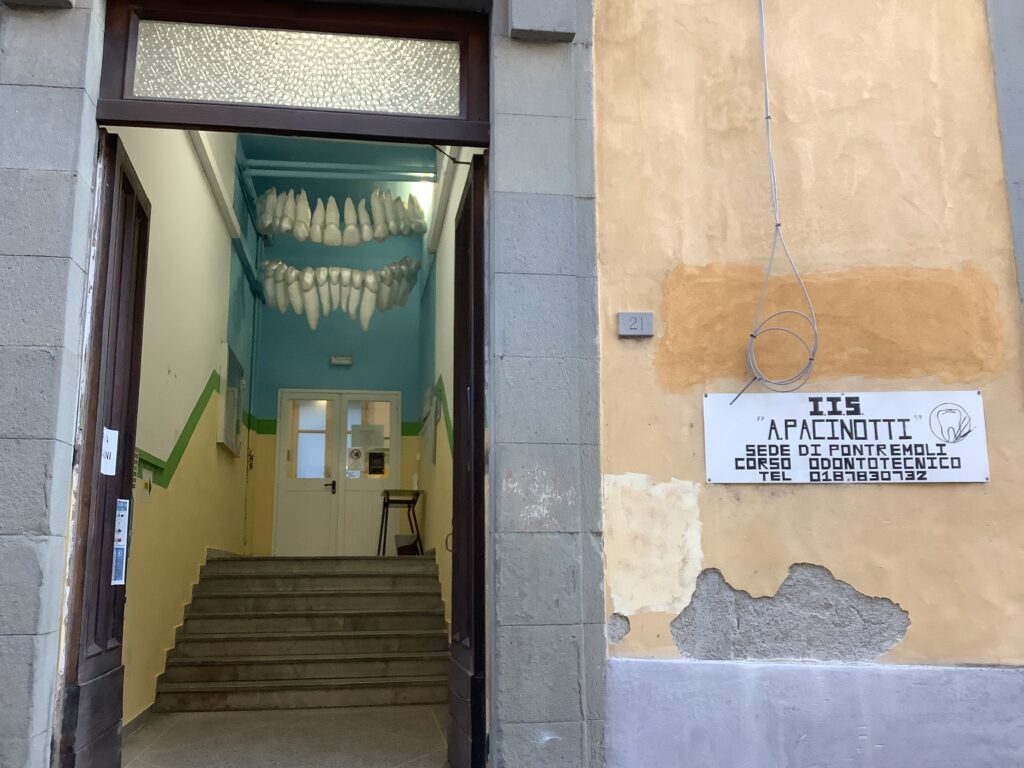
The other side of the river was also packed with more historic buildings in narrow paved streets. Several were being used for ‘studios’ for legal, medical and other professional practices. One in particular which drew our attention appeared to be a training school for orthodontics.

Rather amusing entrance way to the school of orthodontics at Pontremoli

Further on we came upon the only modern building we’d so far seen in Pontremoli: the Chiesa di San Pietro. Originally built on the site of a Benedictine priory, it was largely destroyed in 1944 by WW2 bombing. It was rebuilt in the late 1950’s in a modern style. Although the doorway looked interesting, we weren’t quite sure about the architectural style otherwise. It was particularly unfortunate that it was locked as inside is a 12th century sandstone slab on which a labyrinth is carved representing the passing by of pilgrims. Here is another example of important cultural aspects of the Via Francigena pilgrimage route being hidden and locked away from view. It is difficult to understand why so much EU money is being spent on promoting the VF as a European cultural asset, and even as a candidate UNESCO World Heritage Site, while so many of the actual cultural treasures are locked away from view.

The new Chiesa di San Pietro at Pontremoli
Interesting detail around the doorway

Shortly after, we passed an interesting bronze of Walt Disney characters. Despite the inscription on the plinth and subsequent internet research we remain puzzled by it. We cannot find any particular association between Disney and Pontremoli other than the broad appeal to Italian children.

As is so often the case, it took a while to get clear of the urban area and the rather unattractive light industrial/commercial zone alongside the busy road out of Pontremoli. However, not long after our path pulled up onto the hillside where we found the village and sanctuary of Santissima Annunziata. Here is a 14-15th century church built in order to venerate a painting of the Annunciation – hence the village name. Shortly after its establishment an Augustinian monastery was added. Sadly the church itself was locked but we were able to access the two sets of cloisters on the south side, parts of which are now occupied by the State Archive Section of the Ministry of Culture.

Cloisters of the Santissima Annunciata monastery

Leaving Santissima Annunciata, we passed through terraced vineyards, enjoying the break from the busy road below us.

Vineyards beyond S Annunciata

From here our route continued down the valley of the River Magra to the village of Scorcetoli-Monteluscio, where we stopped for a rest on a convenient bench in the mid-morning sun. No sooner had we sat down, than a white van arrived enthusiastically sounding his horn. Stopping close to us the driver proceeded to open the side of his vehicle and it became clear that this was the butcher and cheese maker doing his local rounds. An elderly lady soon emerged from a nearby house to negotiate her purchase of fresh meat and cheese. There then ensued a conversation between the two which lasted well beyond our departure. Clearly the delivery is more than just that. It serves an important social function in much the same way that our own Postie visits do in rural locations.

We were most impressed by the vegetable gardens in this village. Envy may have described our response to what we saw more accurately, as we passed rows of huge artichokes, cabbages and lettuces continuing to flourish even now in late November.

The benefits of a long vegetable growing season

At the next village Ponticello we found the church of San Giovanni open. Inside it had a distinctly 17th century feel, with high dome over the transept decorated with biblical images. The pillars supporting the dome are dedicated to Matthew, Mark, Luke and John. It was quite light and non oppressive in the way that such imagery we’ve seen elsewhere has been.

Chiesa di S Giovanni at Ponticello

Something which really struck us, however, was the ingenuity used to resolve the matter of church heating. This is a subject which has significantly challenged us in recent years at our home church of St Mary’s.

The ultimate solution to church heating
……and even the priest has his own individual heater!

A little further into Ponticello we came upon the medieval centre of the village with its sandstone buildings and casatorre or fortified house. We interpreted this to be something akin to our own fortified manor houses or the peel towers of Northumberland. Within the narrow alleyways an exhibition of old agricultural implements had been set up and we were given a guided tour by the volunteers who were running it. One particular implement caught Tom’s eye, since less than a month ago he’d been shown one by his old school friend and farmer, Jo. This was a grain cleaning machine for removing weed seeds from threshed grain. Far from being so ancient such machines remain in regular use on a small scale today. Jo bought his quite recently from France and this one is almost exactly the same. Our guide didn’t seem convinced.

Not so ancient grain cleaner
Seed drill

After leaving Ponticello, our path took a wide loop north in order to circumnavigate a Marina Militare: presumably some sort of military or even naval establishment. On crossing the Torrente Caprio we were afforded a clear view of the high mountains to the north of us, demonstrating that the Apennines are rather more than just a chain of hills, but a significant physical barrier to east-west movement.

View to the north of the Torrente Caprio crossing

More oak and ash woodland followed as our path descended back to the flat alluvial plain of the Magra River. Here we found a convenient lunch stop with logs to sit on amongst a group of small agricultural holdings. Here there were orchards of apple and peach trees, vines and a fair amount of market gardening of vegetables. We even came upon a not insubstantial herd of goats, and enclosures of chickens.

Agricultural smallholdings in the Magra alluvial plain

On recrossing the road near Fillatiera we passed the Pieve (parish church) di Sorano. This 10th century building, one of the oldest we’ve seen, was established as a stopping place for pilgrims on the Via Francigena. Unfortunately again it was closed so we couldn’t see inside, but a lady passing by who spoke very good English kindly explained its significance to us.

The distinctly Romanesque east end of the Pieve di Sorano

We’ve yet to understand what the difference is between a pieve and chiesa, but it seems to be something significant. Perhaps one of our Italophile friends could provide an explanation via the comments feed? Manuela? Christina?

Commanding view from Filattiera

From the Pieve di Sorano our path turned left and climbed steeply up to a medieval hilltop settlement. It had been established here for strategic reasons with commanding views over the river valley and the road below. Dating from the 6th century it was established to defend the road against raiding Lombards from beyond the Cisa Pass to the north. Sadly neither the Malaspina Castle nor the Hospital of San Giacomo were open, but we were able to get our Pilgrim Passports stamped at the mairie. At the far end of the hilltop just before our descent is the Chiesa di San Giorgio. Little more than the shell of a building now, it was a place of considerable significance in the 11th and 12th centuries. The bell tower was part of a pre-existing defensive structure for controlling the Via Francigena. On the wall inside are the remains of a tablet commemorating Leadgar, a Missionary Bishop sent by Rome to evangelise the Longobard Aryans.

The Chiesa di San Giorgio and the formerly defensive bell tower adjacent

Dropping off the hilltop we passed another beautiful vegetable garden which filled us with envy.

It’s late November and this vegetable garden is still flourishing.
Eat your heart out Lois!

At the bottom of the hill we were faced with yet another steep climb followed by a stream to ford. Fortunately there were good stepping stones and as the forecast rain hadn’t yet arrived there was little water.

Another steep descent followed by a path through woodland brought us to the edge of Villafranca, our destination for the day.

Unfortunately the information about the location of our accommodation was highly confusing. Villafranca, we found out, has two Via Borgos, about 1km apart. Naturally, we went first to the one in the old part of the town down near the river but could we find Number 19? We have become accustomed now to the confusing way in which buildings are numbered, often in duplicate, but this one had us totally flummoxed. An email followed by a phone call to the proprietor drew no response. By this time the forecast rain had arrived and we began to worry that not only our pre-booked overnight accommodation but that for our much needed rest day simply didn’t exist. It’s at times like this that one needs to stop, calm down and think through all possibilities. A little research on the internet (thank goodness for cellular!) gave us the answer. At the top end of the town, not far from where we’d first entered it, is another medieval walled village with another Via Borgo – Via Borgo Ariberti. Twenty five minutes later, nearly an hour after we’d arrived in Villafranca we found it, and after some negotiation to get a bigger and better room we settled in for a much needed shower (albeit not exactly a hot one).

The right Via Borgo (Ariberti)

After a cold beer in the adjacent cafe/bar, we presented ourselves at the closest eating place (just 50m away) and indulged ourselves with quite the best meal we’ve had since arriving in Italy – and we told them that too!

A sumptuous antipasta of octopus in a porcini mushroom cream was followed by a gorgeous belly pork in chestnut sauce, in Tom’s case, and the most tender rolled goat (kid’s roll) you could imagine, in Julie’s.

Pork belly in chestnut sauce
Kid’s Roll

All was forgiven!

DAY 108 – PASSO DELLA CISA TO PONTREMOLI

We thought supper was to be provided at the hostel last night but when we arrived the warden apologetically explained that he would instead order takeaway pizzas for us from the place we had passed a couple of kilometres down the road. That worked out well, they delivered two huge Quattro Staggioni pizzas and a good bottle of sangiovese. We engaged in an enjoyable conversation with the hostel guardian in a mixture of English, French and the miniscule Italian which we have. It is amazing how when humans want to chat we find a way to do so despite the barriers of language. We talked quite a lot about dogs sharing pictures on our smartphones. He had a Bull Mastiff though not at the ostello. We talked about the wild boar diggings we’d seen in the oak forests. He also told us about the increasing population of wolves in the Apennines. On one occasion he’d been stood outside the door having a smoke when not just one but three wolves sauntered past him on the road!

Breakfast was to be had at the cafe/bar a couple of kilometres up the road, but when we got there we found it closed for holidays. Fortunately we still had the filled rolls we hadn’t eaten for lunch yesterday so we didn’t go completely hungry.

Setting off up the road in fog

Although disappointed about the closed cafe/bar we were pleased to see that the other side of the pass was in bright sunshine, which lifted our spirits again. Passo della Cisa stands at 1041m above sea level, and is both the Apennine watershed and the boundary between the provinces of Emilia Romagna, where we’ve been since Piacenza, and Toscana or Tuscany as we English call it. Once we have crossed Tuscany we shall be almost in Rome, so we are making progress, with more milestones to celebrate today.

Over the Passo della Cisa and into sunshine!
Leaves glowing in the autumn sunlight as we descend from Passo della Cisa

One of the common roadsigns around here states that snow-chains must be carried between 15 November and 15 April, which seems incongruous in the mild weather we’ve been experiencing. Everyone tells us this mild weather is exceptional for November, and judging by the large pile of road salt we found near the pass the locals are leaving nothing to chance. Tom initially thought the small building next to the salt pile was for men working on the road to shelter, but it actually houses a small shrine. The cross on the top was probably the giveaway!

After the closed restaurant at the pass we walked past three more closed restaurants, our hopes of a warm coffee and second breakfast repeatedly dashed. We were wryly amused at the car park for one of the restaurants. Did the driver try to leave without paying the restaurant bill?!

After about three kilometres walking down the road, we had to make a decision: whether to continue on the road, or follow the VF walking route to descend into the valley and ascend the other side, or use a route for VF horse riders on the same side of the valley we were on. We decided on a compromise: to follow the VF walking route down into the valley, but then pick up another minor road to contour down to Pontremoli, avoiding a second climb and steep descent. That choice gave us a good view back to the Passo della Cisa, still shrouded in fog billowing up from the other side, as well as views of the valley we were going to be descending.

Looking back towards Passo della Cisa at the left end of the fog billowing over from the other side – we were glad to be this side today!

Before starting what turned out to be a long and steep descent of about 700 metres, we first had to climb up to an obelisk on top of a spur, La Cucchero, at 994 metres. Unfortunately the explanatory sign had decayed, but the monument seemed to have something to do with the churches in the surrounding valleys as each side of the plinth had images of 2-3 churches with the names of the villages lying in that direction. We later realised the pillar was visible for miles in every direction, serving as a focal point for the surrounding villages. It appeared to have been erected by a local priest – perhaps to represent the churches within his benefice?

Each plaque on the sides of the plinth named a village lying in that direction. Passo della Cisa still shrouded in fog on the horizon
Beginning the long and arduous descent to the bottom of the valley
Beautiful woods but a steep and treacherous path

Just before the village of Cavezzana d’Antena we passed a delightful small olive and walnut grove tucked away in a small bowl in the shelter of the hillside and trees. The village had extensive allotments still producing a wide range of vegetables, including enormous cabbages like we’d seen in other places. The growing season is evidently a lot longer this far south than in Hampshire. By this time we were below the level of the A15 motorway which at this point is on a viaduct high above the village after having passed through a tunnel under the Passo della Cisa. It reminded us of the great tradition of civil engineering expertise that exists in this mountainous country.

Olive and walnut grove at Cavezzana d’Antena
Cavezzana d’Antena and the A15 viaduct

The going was both steep and rough, with lots of loose irregular lumps of stone to twist ankles on. It required a lot of concentration to avoid slipping or falling. In all, the 700 metre descent took us an exhausting couple of hours, and hammered our toes, calves and knees. But the trees and occasional views were wonderfully colourful in the autumn sunlight, with many leaves still green and contrasting with those that have begun to change colour.

A face of concentration

After Julie sprained one ankle and then the other, and Tom’s left achilles started playing up, we decided to stop, rest, and eat our lunch early. We also determined that, for the sake of our bodies, we were definitely going to take the minor road on down to Pontremoli and skip the steep ascent and descent entailed in following the VF walking route.

Vineyard at Gropelli and wonderful view of the mountains

At Groppoli we noticed that vines seemed to be being grown on fruit trees, which we think were peach trees – we also saw new vines growing on very old vines or other types of tree lower down the valley. Each village had extensive allotments with an abundance of vegetables, which seems to be the norm in these remote hillside communities where the nearest supermarket is probably many kilometres away. Who wouldn’t prefer tasty homegrown vegetables anyway?

Orchards and allotments below Groppeli, looking on down the valley

Just below Groppeli we joined the very minor road we had identified on our map and passed by the downhill path taking VF walkers down another steep track to the bottom of the valley. It looked tempting but we didn’t want to push ourselves too hard when there was a more sensible alternative.

Further down the road Julie was surprised to see a well camouflaged slow-worm moving in the leaf litter at the side of the road. Another sign that autumn is very mild here this year, as it should probably be hibernating by now. A bit of internet research suggests that it was an Italian slow-worm as distinct from the more common type of European slow worm found in the UK. Perhaps an expert on reptiles could confirm? Inga? Cousin Jon?

Although we were on tarmac for much of the day, it was not unpleasant as the slope is gentle and the sun was shining, lighting up the autumnal colours. There was also very little traffic – maybe 2-3 vehicles in an hour. At Molinello the bar/cafe was open, so we sat in the sunshine with warm drinks and brioches, watching people come and go: hunters dropping in briefly for their lunchtime shot of caffeine, and a pair of older men out on their trail bikes who were splattered in mud, presumably after trashing some hilly tracks! Plus three dogs out on the razzle, which sniffed around us a little and then headed off down the road in search of more canine interest.

Two or three kilometres before Pontremoli our small road joined a more busy road, so we were back to waving our poles at speeding drivers coming too close for comfort. At one point a sports car came roaring up the road closely followed by a speeding motorbike, apparently racing one another, with some exciting switchbacks in prospect further up the road. It is no surprise that we’ve seen so many damaged crash barriers on these winding mountain roads.

One of several memorials we’ve seen to resistance fighters killed during WW2 – this one in Mignegno near Pontremoli

Once in Pontremoli we were delighted to find the main street blocked to traffic due to the Sunday market, and wandered down a medieval paved street looking for our accommodation. It wasn’t easy to find as there is a duplicate numbering system and we had no idea which was the current numbering. Instead, we decided to see if the cathedral was open – and it was.

Sunday market in Pontremoli centre
The duomo and separate campanile in Pontremoli
Pontremoli cathedral – a little too ornate for our taste, but still impressive for a fairly small town
The cupola above the transept
Sunday street market in full swing
Pontremoli duomo and castello, looking upstream from Ponte Nuovo
Looking downstream from Ponte Nuovo in Pontremoli

Pontremoli, with the emphasis on the trem, literally means trembling bridge – one wonders why. It is full of history and historical buildings, but we sadly had little time to explore, so this is another place to add to our list for a return visit. Having had a quick look around, and the light beginning to fade, we returned to identify our billet, and were given entry to a long corridor leading to an internal courtyard and stairs…all the way to the top! But it was worth the effort of climbing as we had a wonderful view from a rooftop terrace, across the valley, along the river, and over the dome of the cathedral.

View over the cathedral (duomo) from our rooftop seating area

Today’s highlight was the wonderful views of the mountains bathed in autumn sunlight. We have now completed our crossing of the expansive Po valley and the Apennine mountains, and just have Tuscany to walk through to get to Rome. At long last it feels like we are getting there…………slowly but surely.

DAY 107 – CASSIO TO PASSO DELLA CISA

Fully clothed, inside our sleeping bags, with four layers of bedding piled on top and we were just about warm enough to sleep comfortably in our room up under the tiled roof. Today’s clothes had been kept warm in the bottom of our sleeping bags overnight, so getting dressed wasn’t too much of an ordeal. However, our keenly awaited cup of tea with breakfast was foiled by a power cut! Fortunately we knew exactly where we had put our head torches and completed breakfast, minus tea, by torchlight. Lunchtime sandwiches made, we set out at about 0800.

Leaving Ostello di Cassio
Looking across the valley from Cassio
Looking back towards where we came from yesterday

At Cavazzola we left the minor road we had been following and took a woodland track, crunching our way through acorns and collecting fallen leaves on the ends of our walking poles, until we came into the next village, of Castellonchio. It was a long and relentless climb on a horrid substrate of stoney clinging clay. We first encountered this a couple of days ago. As well as being slippery, the clay binds up on the soles of our boots and grips our poles every time they are planted. Nevertheless the woods are pleasant to be in as many of the leaves have still to fall.

At Castellonchio the signs directed us to the church, but sadly it was closed. We liked the memorial to a choirmaster who had served the church community for many decades. It reminded us of our own church choirmaster, Peter who sadly died a few years ago after 23 years of service and is still much missed. The nearby village war memorial lists about twice as many men who died in the First World War as compared with WW2, which is much the same ratio as we saw in French villages. We anticipate that the overall numbers of dead, though relatively few, will have devastated these small communities.

Homage to a former choir master outside the church he served
Castellonchio’s war memorial adjacent to the church

Leaving Castellonchio by road we decided to continue walking on the road, rather than on the designated Via Francigena path. There wasn’t much traffic despite being Saturday, and this would save us some ups and downs. Are we getting lazy?

Walking down through the charming village of Castellonchio

Part way to Berceto a man dressed in hunting garb, including the obligatory item of orange clothing, called out to tell us where the Via Francigena path is, presumably assuming we’d missed it rather than having chosen not to follow it. Approaching Berceto from above we had a good view over the cemetery, separate and some distance from the residential area, as seems to be the norm here in Italy. As with every cemetery we’ve seen so far, it was ablaze with the colours of the many floral tributes.

Berceto cemetery and view across the valley, with the A15 motorway visible on the far side and a brief burst of sunshine lighting up the autumn colours
Berceto and the direction we’re heading in later, contouring along the ridge on the left

We were initially a bit fed up to be directed uphill when Berceto was obviously situated below us, but the entry down an old steep cobbled track was very dramatic and brought us down close to the church just as the bells were ringing out a tune for the midday Angelus.

Descending steeply into Berceto on a long cobbled track

We’re not sure why, but the church in Berceto is described as a ‘duomo’ or cathedral, although it isn’t especially large and neither is Berceto. We didn’t find any information about it, but it looks to be 12th or 13th century, with relatively simple architecture and only slightly pointed arches. Inside it was very dark, but we then found the slot in which to place a one euro coin to turn the lights on, which made all the difference.

There was a good sized organ, which we later heard being played, and a museum where the historical treasures were safely locked away but could be viewed. We were intrigued by what appeared to be part of an old painting or fresco of the Madonna and child behind a perspex screen on one of the pillars, but there was no information about it.

The church was warm, and we noted that there appeared to be underfloor heating ducts with grilles allowing warm air into the building, just like the heating system in our church at home…except that Berceto’s grilles are more ornate and artistic than ours. There seems to be a tradition of artistic metalworking here, judging by the many and varied gates and window grilles we’ve seen which are more than just functional.

Sight-seeing done we decided to find somewhere for lunch rather than eating our sandwiches which will keep for tomorrow. Just across the street from the church was a promising looking trattoria and bar. They produced a good lunch for us, and for several other customers eating out for their Saturday lunch. At the same time the bar was doing a good trade in prosecco and espresso coffees, which we’ve noticed are often consumed together in bars, and not just on Saturdays. Judging by the looks we were getting, some of the customers clearly thought we were rather daft being dressed in shorts in mid-November. They had a point, which is partly why we liked the idea of lunch in a warm bar!

Walking through Berceto’s quaint cobbled streets

On the way out of town we passed an interesting modern sculpture on the roadside which appears to depict a pilgrim walking barefoot. Not something we intend to try! Our feet are taking quite a battering even with the protection of modern good quality walking boots.

We initially followed a track leading upwards towards Lugo, which is just a few houses by the roadside, and then walked along the road to make sure we found our accommodation.

Part way along the road we met a Frenchman and his lovely dog. He told us that he was from La Rochelle. He’d walked to Rome from Briancon over the Montgenevre pass and was now returning on foot to France. We noted that we walked in sandals. He explained that he’d walked many of the pilgrim routes in Europe, describing himself as a bit of a pilgrim. Whilst we were talking with him another pilgrim arrived walking in the same direction with pack and staff. It transpired that he is a Swiss soldier and has been working at the Vatican as a Swiss Guard for the last two years and is now returning home to Lucern on foot. What a wonderful encounter this was. Every pilgrim we meet on the way seems to have such an interesting story to tell.

Pilgrims meeting on the road between Berceto and Passo della Cisa: our French friend from La Rochelle with his dog on the left and the Swiss Guard in the middle.

A bit further up the road, now walking in low cloud or fog, we arrived at Ostello della Cisa, our accommodation for the night, and were welcomed by the very friendly warden. Tonight we had the benefit of a stove blasting away all evening, which took the edge off the cold, but only just. We still needed to use our sleeping bags again.

Arriving at Osteria della Cisa in the fog

These Ostellos seem to be run by the local commune and provide basic accommodation at a modest cost for pilgrims and travellers, in the historical tradition. We have been very grateful for them because there is no other accommodation to be had in these remote mountains, and we are physically incapable of walking longer distances or going kilometres off track in search of somewhere to stay. Using them has been a bit of a challenge for us because of our completely inadequate Italian, but Julie’s cousin’s Italian wife Manuela very kindly made the bookings for us, and volunteered to interpret by phone once we got there. We found that Silvana at Cassio spoke French, and at Passo della Cisa a mixture of languages plus a translation app got us through.

Today’s highlight? Well, meeting and talking with the other pilgrims was fascinating.

DAY 106 – FORNOVO DI TARO TO CASSIO

Our accommodation last night was very comfortable, and our hostess was attentive and kind. The old oak tree in the back garden, for which the house is named, is still in full leaf because the weather has been unseasonably mild. Our hostess was an excellent cook, and we were treated to both a good supper and a delicious cheese omelette for breakfast: much appreciated after weeks of sweet buns and biscuits for breakfasts.

B&B La Vecchia Quercia (the Old Oak) with the lovely family dog Moon in the yard

We set out in fog and full cloud cover, but as the day wore on the sun burned off the fog and we had clear blue skies for most of the day. Given the dubious forecast we were very lucky, and had many wonderful views.

Setting off uphill in the early morning murk

Having climbed above where we stayed last night we were immediately directed down a steep hill into another valley, in theory opening up new views, though at that stage of the day the sun was still fighting to get through the fog and we could see only tantalising glimpses. Our hips and knees took their first serious pasting for a couple of weeks, but that’s half the price we have to pay for spectacular hilltop views – the other half being the effort to get up there!

Descending steeply into the valley almost hidden in the fog below
A moment of hilarity on our way down the steep hill

Once at the bottom of the hill we then began a long and gradual climb up the valley using the road, sending the usual semaphore messages with walking poles to fend off cars coming past too fast and too close. Several of the villages in these valleys have food processing plants which no doubt provide valuable employment for local people, though it wasn’t easy to work out what processes were taking place as all the signs were about keeping out.

The battle between sunshine and low cloud went on for a couple hours, and fortunately the sun won out eventually
The sun beginning to win the battle – much to our relief as we were otherwise walking into bad weather and no views

At the village of Sivizzano, tucked away behind the church in what appeared to be the courtyard to a house, we found the cloisters of a former Cistercian or Benedictine (the notice about it mentioned both) ospidale which had provided shelter to pilgrims and travellers in medieval times. Unfortunately the church itself was locked, but the cafe in the nearby square was open and we stopped there for a mid-morning cafe latte. We are getting into a habit with this! But we also recognise the social importance of cafes in small isolated villages. Several older gentlemen came in for a glass of Prosecco and an espresso while we were there.

The Cistercian /Benedictine cloister adjacent to the church
The church and cafe in Sivizzano

As we were leaving the village we spotted an interesting building across the street with an explanatory plaque which turned out to be an old wood oven typical of the Apennines. We realised we’d seen several similar buildings already without knowing what they were. We assume that all the bread (or pizza?) for the village was baked here at one time.

Just up the road we had the choice of staying on the road or taking a diversion along farm tracks, and opted for the latter as the seasonal stream we would have to ford wasn’t flowing. The farm tracks are not recommended in bad weather or when the river is in spate, but today was no problem as there has been so little rain this autumn. By this time the sunshine had broken through and the leaves were glowing in their autumn colours. We also spotted a small group of deer across a field, the first we’ve seen despite frequent roadside warnings about them.

The torrente was pretty well dry today
Tom spotting a small group of deer in the field – the specks up near the trees!

Back onto the tarmac road we then climbed on up the valley to the village of Bordone, perched on a hillock, by this time with wonderful views up and down the valley we had been gradually ascending all morning.

View across the valley below Bordone – note the drainage channel gouged across the field of winter wheat in the foreground
View back down the valley from Bordone

In Bordone we went to have a look at the church and found a group of six Italians from Milan in the process of getting hold of the custodian of the key to unlock the church, so we decided to wait for that to be sorted out. What a surprise was in store! Inside a church which has been modernised there is a collection of stone carved friezes and statues dating from the 12th century, plus a 17th century embroidered silk gown and a display case containing archaeological finds dating from the Bronze Age. Not at all what we expected to see in a small village church, and it made us wonder what we’d missed in the other small locked churches we’ve walked past.

We were quite blown away by the treasures in this small church, and very glad we’d decided to wait whilst the key holder was tracked down. She also kindly offered to stamp our pilgrim passports for us. We then accepted the good wishes of the Italian group for the rest of our walk, and carried on up the road. Just at the edge of the village a couple of tables and seats had been set up for use by pilgrims so, as it was near enough lunch time, we decided to use them and to sit and admire the view for a while.

Pilgrims’ picnic spot outside Bardone

From Bardone we continued to climb up the valley, gaining another 150 metres in height by the time we reached the next village of Terenzo, perched on a steep hillside overlooking the valley we had come up this morning. By this time the early morning cloud at the top of the valley had transformed into afternoon temperature inversion at the bottom of the valley, with a wall of cloud moving slowly up behind us.

Looking back towards Bardone and the gathering cloud in the valley below
A large cricket sunning itself on the warm road – risking being flattened by a speeding car!

Little did we realise that the biggest challenge of the day was yet to come, with a steep and relentless climb up from Terenzo to the ridge above, gaining some 250 metres in height over a couple of kilometres. As we were amongst trees we didn’t often get a view back or ahead, and each time the path levelled off we thought we were nearly there, only to find another steep climb around the corner. This was undoubtedly the toughest part of the day.

Beginning the steep climb up from Terenzo – a false dawn ahead!
Onwards and upwards…
Still climbing!

When we reached the col at last we were rewarded with wonderful views over the next valley, half of it still in late afternoon sunlight, and the village of Casola. At this point the path took us down into the valley and back up the other side, whilst the road contoured around…so we followed the road as we’d had enough of climbing for now.

After Casola we decided to shorten our remaining walk by following the road or other tracks to avoid what appeared to be unnecessary descents and re-ascents. Much of it was in mixed deciduous and then coniferous woodland, making for very pleasant walking with intermittent views between gaps in the trees. As we were now on the sunny side of the ridge we’d climbed up to from Terezano the autumn colours were glorious.

Entering Cassio in late afternoon sunshine – no fiddling with camera settings needed!

We arrived in Cassio, our destination for today, within about half an hour of sunset, with the sun slanting across the road lighting up the trees. It was spectacular!

Tonight we are staying in the village’s pilgrim hostel which has been re-opened for us as the season ended at the end of October and there is no other accommodation in the vicinity. It is very cold and the heating has not been put back on, so our sleeping bags will be put to good use tonight, probably with some clothes too! At least there is good hot water for showers, and our meals are being provided as none of the village’s eating places are open.

Tom togged up and hoping to be warm enough to sleep!

We have again been very fortunate with the weather, and enjoyed wonderful views for most of the day. The church in Bardone and its display of old stone carvings was most unexpected, and it was only by lucky chance that we saw them. We’ve been wondering what the Apennines would be like in the spring, but they are certainly spectacular in autumn with the leaves turning colour. It has been a good day, and all that climbing has been worth the effort! Now we just hope we can stay warm enough to get a good sleep tonight.